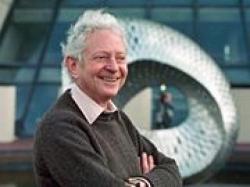
George Gamow
 USA
USA- Biography of Georgiy Gamov
- Early Career and Achievements
- Contributions to Astrophysics and Cosmology
- Personal Life and Legacy
Biography of Georgiy Gamov
Georgiy Antonovich Gamov, also known as George Gamow, was a physicist, astrophysicist, and cosmologist. Born on March 4, 1904, in Odessa, Ukraine, he was a highly accomplished scientist whose contributions to the field of physics and cosmology were groundbreaking.
Early Career and Achievements
In the early 1930s, Gamov was considered one of the brightest minds in physics, surpassing even the esteemed genius Lev Landau. At the age of 24, he conducted Nobel-level research, developing the theory of alpha decay, one of the four types of radioactivity. By the age of 28, Gamov became the youngest corresponding member of the USSR Academy of Sciences in its history.
However, in 1933, Gamov became the first non-returning scientist, breaking his promise to return to the USSR after a research trip abroad. This led to his name being officially forgotten in his home country. Despite being excluded from the USSR Academy of Sciences, Gamov continued to work actively and successfully in the West. He joined the University of Washington in Washington, D.C., in 1934, and in 1936, together with Edward Teller, the father of the hydrogen bomb, he formulated the theory of beta decay, another type of radioactivity.
Contributions to Astrophysics and Cosmology
While Gamov was not involved in the atomic bomb project due to his questionable origins from an American perspective, he began working on the hydrogen bomb from 1949 and even visited the Bikini Atoll, the US atomic testing site. Gamov became one of the brightest stars in astrophysics and cosmology. He was the first to calculate models of stars with thermonuclear reactions, proposed the model of a red giant's shell, and investigated the role of neutrinos in the flashes of new and supernova stars. He also developed the theory of chemical element formation through neutron capture. After World War II, he put forward the bold and now widely accepted theory of the "hot universe," which led to the existence of relic radiation formed during the Big Bang. Gamov's theory was confirmed by the experiments of Penzias and Wilson, who later became Nobel laureates in 1978.
In 1954, Gamov published an article in which he was the first to address the problem of the genetic code, proving that "when four nucleotides are combined in triplets, there are 64 possible combinations, which is sufficient to encode hereditary information." In 1968, Americans Holley, Khorana, and Nirenberg received the Nobel Prize for deciphering the genetic code. Unfortunately, these awards were granted after Gamov's death on August 20, 1968.
Personal Life and Legacy
Gamov came from an esteemed family background, with one of his grandfathers serving as the commander of the Odessa Military District and another as a metropolitan bishop. His father, a state councilor, taught at the Odessa Gymnasium, where one of his students was the future leader of the world revolution, Leon Trotsky. Gamov was fluent in six languages and considered himself not a Soviet boy but rather a European intellectual.
During his student years at Leningrad University, Gamov formed a jazz band with future Nobel laureate Lev Landau and other talented musicians. This jazz band pioneered the cosmopolitan style of communication that became prevalent among intellectuals in the 1960s during the debates about "physicists and lyricists." Physicists played a central role in this world, and Gamov's band had a motto: "it is unattractive to be famous if you are not beautiful." They published a journal called "Discards of Physics" and organized wit parades while constantly testing each other's erudition. Physics was at the center of this world.
Gamov and his wife, known as "Ro," started looking for a way to leave the Soviet Union. They attempted to reach Turkey by kayak from Crimea and searched for the Finnish border on skis but were unsuccessful. Finally, with the help of Nikolai Bukharin, Gamov was granted an overseas passport, and remarkably, his wife also received one. In 1934, Kapitsa, a renowned physicist, was not allowed to leave the USSR on his last visit abroad. Gamov vehemently denied being the reason behind Kapitsa's detention.
After settling in the United States, Gamov wrote numerous fundamental works in physics. Despite his undeniable contributions and remarkable talent, he was not canonized, and the Nobel Prize eluded him. He did, however, receive the UNESCO Science Popularization Award, where he had no equal since his student days with the "Discards of Physics." Gamov's beautiful wife left him during his time in America, and he relocated to a provincial university. Rumors circulated that he drank heavily in his final years. Gamov passed away in 1968, almost simultaneously with his friend from youth, Lev Landau. In 1990, Georgiy Gamov was posthumously reinstated as a corresponding member of the USSR Academy of Sciences.
It remains uncertain whether Gamov's failure to return to the USSR and his subsequent treatment contributed to the many years of quarantine behind the "Iron Curtain" that isolated Soviet science from the rest of the world. Perhaps Gamov had a premonition of its inevitability.