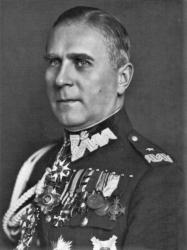
George Rokuell
 USA
USA- Early Life and Education
- Intellectual and Political Evolution
- Military Service and Experiences
- Post-War Career and Political Awakening
- Radicalization and the Formation of the American Nazi Party
- Influence of William F. Buckley Jr. and Growing Extremism
- Seclusion, Conflict, and Public Appearances
- The Playboy Interview and Later Activism
Early Life and Education
George Lincoln Rockwell was an American naval officer and the founder of the American Nazi Party. Born in Bloomington, Illinois, he was the eldest of three children. His father had English and Scottish ancestry, while his mother was of German and French descent. Both of his parents were actors who performed in vaudeville and comedies. Rockwell's father's circle of friends included renowned figures such as Fred Allen, Walter Winchell, Jack Benny, and Groucho Marx. Rockwell later attributed his public speaking and audience engagement skills to his early childhood experiences.
At the age of six, Rockwell's parents divorced, resulting in a childhood divided between his mother's home in Atlantic City, New Jersey, and his father's residence in Boothbay Harbor, Maine. Rockwell attempted to enroll at Harvard University but failed the entrance exam. He spent a year not pursuing any particular activity until his father sent him to Hebron Academy in Lewiston, Maine. There, he became engrossed in the study of philosophy and works addressing societal development.
Intellectual and Political Evolution
Rockwell's intellectual pursuits led him to reassess his religious views. Initially a devout believer, he later declared himself an atheist after reading the Bible critically. However, his relationship with religion eventually evolved, as he came to view it not as "the opiate of the masses" but as a necessary pillar of civilization. In his later years, he acknowledged the possibility of a higher power in the universe and identified as an agnostic. Near the end of his life, he drew comparisons between himself and the Apostle Paul, promoting the racist Christian Identity sect in an attempt to appeal to conservative Christian demographics.
In 1938, Rockwell enrolled at Brown University in Rhode Island, where he studied philosophy. In his sociology courses, he vehemently opposed the prevailing notion that one's environment shaped them and that all individuals had equal potential at birth. Rockwell instinctively rejected the concept of equality, though at the time, he had yet to develop his own framework to justify his feelings. He gradually aligned himself with conservative viewpoints and honed his debating skills.
Military Service and Experiences
During his sophomore year, Rockwell dropped out of university and enlisted in the Navy. In 1940, he was sent to aviation training in Massachusetts and Florida and became a naval aviator. After completing his training, he was assigned to Norfolk, Virginia. During World War II, black servicemen were segregated from whites, but according to his fellow service members, Rockwell was not hostile towards them. For instance, during a celebration of the victory over Japan, he gifted several black personnel a bottle of champagne.
Rockwell served in the South Atlantic aboard the USS Omaha, tasked with detecting enemy submarines. He flew a Curtis seaplane, launched from the ship via catapult. On April 24, 1943, Rockwell married Judith Altman, whom he had met while attending Brown University. After his marriage, he continued his training at the School of Aerial Photography in Florida and later served in the Pacific Theater. His most notable operational involvement was in providing aerial support during the Battle of Guam.
Post-War Career and Political Awakening
Upon the conclusion of the war, Rockwell ventured into commercial photography, illustration, and graphic design. In the spring of 1946, he opened a photography studio and discovered the financial feasibility of such a venture. The same year, he enrolled at the Pratt Institute and relocated to New York City with his wife.
During his time at Pratt, Rockwell became involved in the contemporary art movement. However, he perceived modern art as foreign and even labeled it "communistic." He also believed that Jewish individuals were the driving force behind contemporary art and mistakenly assumed that Pablo Picasso was Jewish. In 1948, he won a $1,000 prize for an advertisement he created for the American Cancer Society, a contest sponsored by the National Society of Illustrators.
Without completing his final year at Pratt, Rockwell left the institute and established his advertising agency in Maine. His commercial career was interrupted when he was recalled to active duty due to the Korean War. He relocated with his wife and children to San Diego, California, where he trained alongside fellow pilots for aerial support operations.
It was in San Diego that Rockwell began to take interest in politics. He was captivated by Senator Joseph McCarthy's anti-communist radio addresses and endorsed Douglas MacArthur as the Republican presidential candidate. Throughout his life, he would maintain admiration for both McCarthy and MacArthur, even adopting MacArthur's signature pipe-smoking habit.
Radicalization and the Formation of the American Nazi Party
However, Rockwell's conservative leanings soon gave way to more extreme ideologies. He read Hitler's "Mein Kampf" alongside "The Protocols of the Elders of Zion" and embraced a Nazi worldview. He penned and published a satirical piece akin to Orwell's "Animal Farm," titled "The Fable of the Ducks and the Hens," wherein he portrayed 20th-century America as being under Jewish domination. By 1952, he was actively collaborating with anti-Semitic and anti-communist groups. He joined the Christian Educational Association, founded by Conde McGinley, who viewed communism as an expansion of Judaism.
Upon his second return to civilian life, Rockwell sought to generate income by publishing a magazine catering to wives of American service members. In September 1955, he launched "U.S. Lady." He attempted to promote the project by connecting with public relations generals and admirals from various military branches. Rockwell's vision for the magazine extended beyond financial gain; he intended to use it as a platform for his political views, advocating against racial integration and communism. Funding for the project primarily came from Rockwell's stock trading activities. However, the magazine struggled to sell, and financial constraints forced Rockwell to relinquish his stake in it. Nevertheless, he continued to harbor aspirations of becoming a successful publisher.
Influence of William F. Buckley Jr. and Growing Extremism
For a period, Rockwell worked for William F. Buckley Jr., promoting his publication "National Review" among conservative students. Eventually, he came to view conservatives as "ostrich people" who failed to face the enemies he perceived within the Jewish community. Rockwell attempted to organize his conservative newspaper and later his own political organization within the conservative camp, but both met with failure.
Rockwell's activities gained notice among other far-right extremists. One day, he received a package containing an eight-foot Nazi flag with a swastika from a supporter. He displayed the flag in his home, surrounding it with an altar featuring Hitler's portrait and three candles.
In March 1959, Rockwell founded an organization named the World Union of Free National Socialists, which was later renamed the American Nazi Party in December of the same year. The party's headquarters were in Arlington, Virginia. The party's formation resulted in Rockwell's dismissal from the military and the loss of his pension.
Seclusion, Conflict, and Public Appearances
Out of security concerns, Rockwell sent his second wife and children to live in Iceland, his wife's homeland. Initially, he believed the separation would be temporary, but the rift between them grew over time. Rockwell traveled to Iceland with hopes of reconciliation, but it proved futile, and he eventually divorced his wife. Meanwhile, Rockwell's relationships with his immediate family deteriorated. His brother and sister refused to speak to him, and his father disowned him for tarnishing their family name. Only his mother maintained contact with him.
Seeking to draw media attention, Rockwell organized a party rally in Washington, D.C.'s National Park on April 3, 1960. Rockwell spoke for over two hours and gained significant public attention.
He planned a subsequent rally in New York City's Union Square. Rockwell attended and demanded a permit to deliver a speech. To reporters, he declared that 80% of the Jewish population in the U.S. were communist sympathizers and thus should be gassed like traitors. However, Rockwell's request to hold the rally was denied.
Rockwell's third planned rally was scheduled for July 3, 1960, once again in Washington, D.C.'s National Park. Upon Rockwell and his supporters' arrival, they were met by a hostile crowd, leading to confrontations. Rockwell and eight other party members were arrested. Rockwell demanded a court hearing but was instead sent to a mental hospital for a 30-day psychiatric evaluation. Less than two weeks later, he was released and deemed sane. Afterward, he became more cautious in his public statements.
The Playboy Interview and Later Activism
In early 1966, Rockwell granted an interview to Alex Haley, which was published in the April edition of Playboy magazine. He agreed to the interview, he claimed, because the magazine targeted white male demographics. For many, it was the first publication in which Rockwell's beliefs were presented uncensored.
During the summer of 1966, Rockwell co-led a counter-demonstration against Martin Luther King's demonstration against de facto segregation in a white Chicago suburb. Rockwell viewed King as a tool of the Jewish communists who sought to integrate America based on their communist ideals of equality.
Rockwell and his party also assisted the Ku Klux Klan and related groups, such as the White Citizens Council, in disrupting civil rights marches, including the famous March on Washington. However, Rockwell came to believe that the Ku Klux Klan represented an outdated approach and was ineffective in combatting modern-day enemies.
During this period, Rockwell's party developed a friendly association with the Nation of Islam. A primary factor in their alliance was the shared belief in racial segregation.