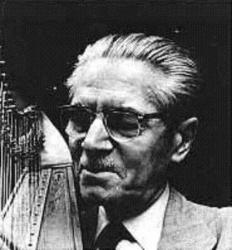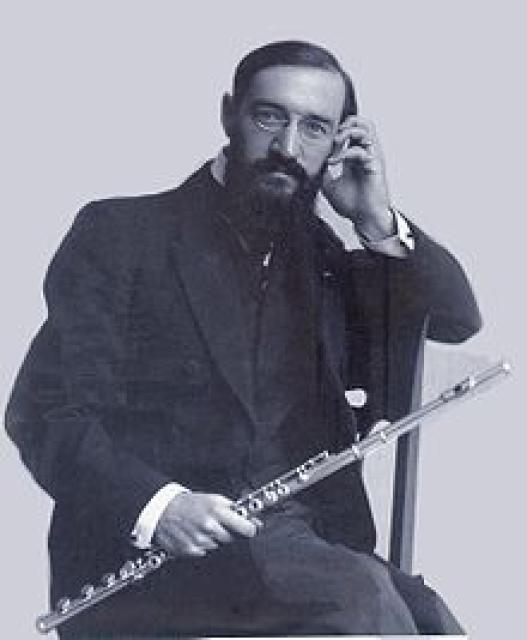
Georges Barrere
 USA
USA- Early Life and Education
- Musical Beginnings
- Wartime and Conservatory
- Influence of Claude Taffanel
- Professional Career in France
- Emigration to the United States
Early Life and Education
Georges Barrère was born in France on October 31, 1876, to a carpenter father and a farmer's daughter mother. Though his parents had little interest in music, they recognized his talent and encouraged him to pursue a musical career instead of carpentry. In 1879, the family moved to Paris, and in 1886, they settled in Épernon.
Musical Beginnings
Barrère's older brother initially inspired his passion for music, first playing a tin whistle and later a violin. Georges followed in his brother's footsteps but opted for the flute. At a young age, he surpassed his brother's musical abilities, displaying exceptional virtuosity on the six-keyed instrument. Despite attending a modest village school, Barrère benefited from Jules Ferry's law, which guaranteed free education for all French children. He joined the local orchestra under the direction of the school's principal, M. Chouet.
Wartime and Conservatory
The Franco-Prussian War briefly interrupted Georges's musical education, but he was fortunate to have an instructor who encouraged his musical pursuits. The instructor recommended his teacher, Léon Richaud, with whom Barrère studied the flute. Richaud arranged an audition for the Paris Conservatoire, but Barrère initially failed to pass the entrance exam. However, he was permitted to attend the classes of Professor Henry Altès on a weekly basis. At age 14, Barrère successfully auditioned a second time and was admitted to the Conservatoire.
Influence of Claude Taffanel
Barrère's progress under Altès, though slow, was accelerated by the arrival of Claude Taffanel as his teacher in 1893. Taffanel emphasized musicality and analysis rather than the repetitive exercises favored by his predecessor. This approach transformed Barrère's playing, giving him confidence and encouraging him to experiment. In 1895, Barrère won his first musical competition.
Professional Career in France
While still in his teens, Barrère earned money by playing in orchestras to help finance his studies at the Conservatoire. After graduating, he founded the Société moderne d'instruments à vent, a wind ensemble that performed regularly at the local opera house. In 1897, he became an instructor at the Collège Stanislas and also secured a position as flutist in the prestigious Concerts Colonne orchestra. With the orchestra, Barrère traveled throughout Europe, gaining invaluable experience.
Emigration to the United States
In 1905, Leopold Damrosch invited Barrère to join the New York Symphony Orchestra. Barrère accepted the offer and remained in the United States for the rest of his life. He became one of the most influential flutists of the 20th century, known for his exceptional technique, virtuosity, and musicality.