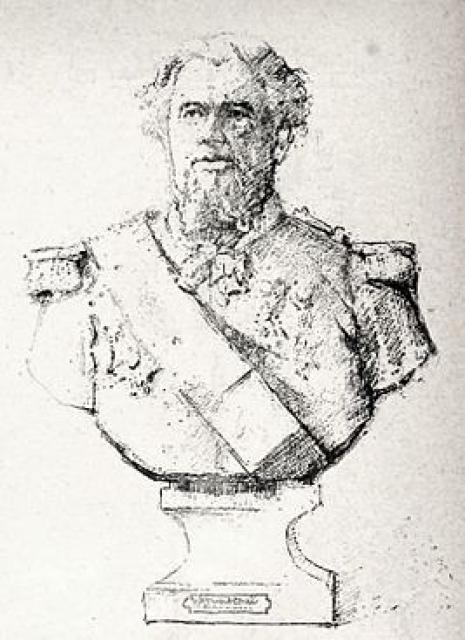
Georges Charles Cloue
 France
Georges Charles Cloué rose from a young naval aspirant to vice admiral and France’s minister of the Navy and the Colonies. His career spanned decades of French naval expansion, service in the Caribbean and Pacific, and high-level administration. Alongside command, he made a lasting contribution to hydrography, producing charts and sailing instructions for mariners.
Early Naval Career
Cloué was born in Paris on August 20, 1817. He entered the French Navy in 1832 and became an aspirant, or officer cadet, the following year. He advanced through the ranks, becoming an ensign in 1839, lieutenant in 1846, commander in 1855 and captain in 1862.
His early assignments took him across the Atlantic and into the Caribbean and South America. He served during the French intervention in Mexico and the Crimean War, gaining experience in both naval operations and command. In 1867 he was promoted to rear admiral. He later commanded a naval division in the Pacific and, in 1874, attained the rank of vice admiral.
Administrator and Minister
Cloué held a series of senior posts as France expanded its naval and colonial reach. He served as governor of Martinique from 1871 to 1874, administering the Caribbean colony in the decades after slavery’s abolition. He later served as maritime prefect at Cherbourg and commanded the Atlantic evolution squadron, a fleet used for training and exercises.
In September 1880, Cloué entered the cabinet of Jules Ferry as minister of the Navy and the Colonies. He held the portfolio until November 1881, overseeing both naval affairs and French colonial administration. He was also associated with senior naval advisory bodies and the government’s work in maritime affairs. He left active service in 1883 and served as a councillor of state later in the decade.
Hydrography and Scientific Work
Cloué’s reputation extended beyond command and public office. Throughout his naval career, he pursued hydrographic work, measuring coastlines and preparing charts and sailing directions. He contributed to charts of Réunion and other waters encountered during his service, and his publications included *Pilote de Terre-Neuve* and instructions covering Patagonia, the Strait of Magellan and Tierra del Fuego.
He also wrote on ocean and weather conditions. His published work on the June 1885 hurricane in the Gulf of Aden reflected a broader interest in the practical science of navigation. He served in leadership roles connected with France’s hydrographic services and scientific institutions, including the Bureau des longitudes.
Final Years and Legacy
Cloué received several distinctions for his service, including the Grand Cross of the Legion of Honor in 1881. He died in Paris on December 25, 1889, aged 72, and was buried in Chantilly.
His life illustrates the close ties between naval command, colonial administration and scientific surveying in nineteenth-century France. The charts and navigational works associated with him preserved the results of years at sea, while his rise to the cabinet placed him among the senior figures responsible for directing France’s maritime policy.


