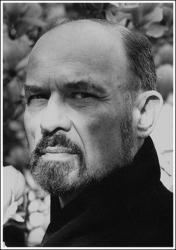
Georges Devereux
 USA
USA- Early Life and Education
- Conversion to Catholicism and Ethnoanthropological Research
- Wartime Service and Psychoanalytic Training
- Contribution to Behavioral Sciences
- Later Life and Legacy
Early Life and Education
Georges Devereux (born György Dobó) was born into a Jewish family in Banat, a region spanning modern-day Hungary, Romania, and Serbia. His father, a Hungarian-speaking lawyer, and his German-born mother had a complex relationship with young György, who later expressed his dissatisfaction with "the dishonesty of adults" and the "lack of respect for the children's world."
Fluent in Hungarian, Romanian, German, and French by his teenage years, Dobó's aspirations for a career as a pianist were dashed by a failed surgery. After his brother's suicide, he relocated to Paris to study chemistry and physics under Marie Curie, later incorporating scientific concepts into his works.
After stints in Leipzig as a publishing intern and back in Paris, he enrolled at the National Institute for Oriental Languages and Civilizations, studying Malay and meeting influential figures such as Marcel Mauss and Klaus Mann. He also penned an unpublished novel, "Le faune dans l'enfer bourgeois."
Conversion to Catholicism and Ethnoanthropological Research
In 1933, Dobó converted to Catholicism and took the name Georges Devereux. With a Rockefeller Foundation grant, he embarked on fieldwork among the Mojave Indians in the United States. His initial reception by American anthropologists was skeptical, as they were unfamiliar with European authorities like Mauss, Paul Rivet, and Lucien Lévy-Bruhl. Yet, for Devereux, his time among the Mojave was the happiest of his life. Their emphasis on dreams, he claimed, "converted" him to Freudianism. He completed his doctoral dissertation under A. Kroeber.
Wartime Service and Psychoanalytic Training
From 1943, Devereux served in the US Army. Following psychoanalysis with Mark Schlumberger and Robert Jokl, and further training at the Menninger Clinic, he worked as a child and adolescent psychoanalyst from 1953 to 1955. In 1956, he settled in New York City.
Contribution to Behavioral Sciences
Devereux's book "From Anxiety to Method in the Behavioral Sciences" challenged the conventional belief in objective observation. He argued that instead of attempting unbiased observation, researchers should acknowledge their own influence on the observed phenomena. This perspective influenced later developments in qualitative research.
Later Life and Legacy
In 1963, at the behest of Claude Lévi-Strauss, Devereux joined the faculty of the École pratique des hautes études in Paris, teaching until 1981. His final years were devoted to the study of Greek antiquity, culminating in a book on Greek tragedy.
Georges Devereux made significant contributions to ethnoanthropology, ethnopsychiatry, and the bridging of psychoanalysis with cultural research. His legacy continues to inspire scholars in these fields.