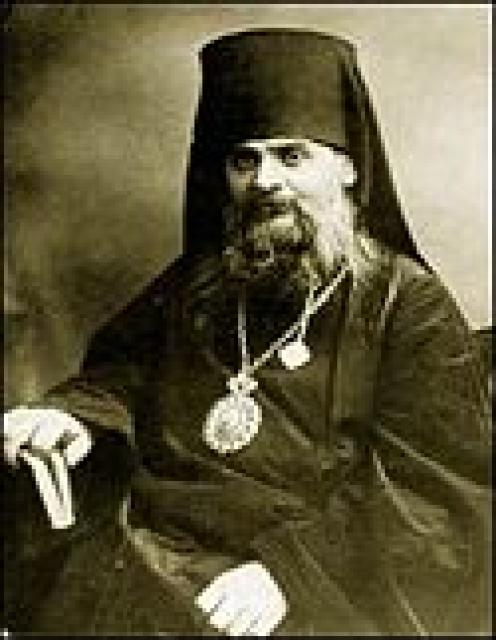
Georgiy Dolganev
 Russia
- Early Life and Education
- Monastic Life and Ecclesiastical Career
- Bishop of Volsk and Saratov
- Political Views and Controversy
- Conflict with the Holy Synod
- Bishop of Tobolsk and Siberia
- Martyrdom and Canonization
Early Life and Education
Born into a priestly family, Herman (Hermogenes) Dolganev began his ecclesiastical education at a seminary. He subsequently passed examinations for a maturity certificate at a classical gymnasium. In 1886, he graduated from the Faculty of Law at Novorossiysk University. He also completed coursework in mathematics and attended lectures at the university's Faculty of History and Philology. In 1893, he obtained a Candidate of Theology degree from the St. Petersburg Theological Academy.
Monastic Life and Ecclesiastical Career
In 1890, Herman was tonsured a monk and ordained a hierodeacon. Two years later, he was ordained a hieromonk. From 1893, he served as an inspector at the Tiflis Theological Seminary. In 1898, he became the rector of the seminary and was elevated to the rank of archimandrite. He also served as a member of the Georgian-Imereti Synodal Office and Chairman of the Diocesan Council of Education. During this period, he was editor of the "Spiritual Bulletin of the Georgian Exarchate."
Bishop of Volsk and Saratov
In 1901, Herman was appointed Bishop of Volsk, a vicarage of the Saratov diocese. Two years later, he became Bishop of Saratov and Tsaritsyn. Throughout his tenure, he emphasized proper and reverent liturgical practice and actively combated sectarianism. He expanded the diocesan newspaper, established several new publications, and oversaw the construction of over fifty new churches.
Political Views and Controversy
During the 1905 Revolution, Herman emerged as a staunch anti-revolutionary. He delivered sermons condemning revolutionary movements and played a key role in organizing a local chapter of the Union of the Russian People. He was known for his conservative views and criticized contemporary trends in literature and theater. In 1911, he sent a telegram to the Emperor opposing the introduction of deaconesses into the Orthodox Church.
Conflict with the Holy Synod
Herman's outspoken views led to a clash with the Holy Synod. In 1912, he was ordered to leave the Synod and return to his diocese. However, he refused to comply and gave interviews to newspapers criticizing the Synod members. As a result, he was suspended from his diocesan duties and sent to the Zhirovitsky Monastery.
Bishop of Tobolsk and Siberia
In 1917, following the fall of the monarchy, Herman was appointed Bishop of Tobolsk and Siberia. He retained his monarchist beliefs and strongly opposed the Bolshevik regime. His support for Nicholas II and alleged attempts to organize former frontline soldiers led to his arrest.
Martyrdom and Canonization
In 1918, Herman was imprisoned and subsequently drowned in the Tur River by Bolshevik authorities. His remains were discovered and buried by locals. In 1998, he was canonized as a locally venerated saint of the Tobolsk diocese. In 2000, the Jubilee Holy Synod of the Russian Orthodox Church recognized him as a New Martyr and Confessor of Russia. Along with three other priests, he was also canonized for his suffering and martyrdom.