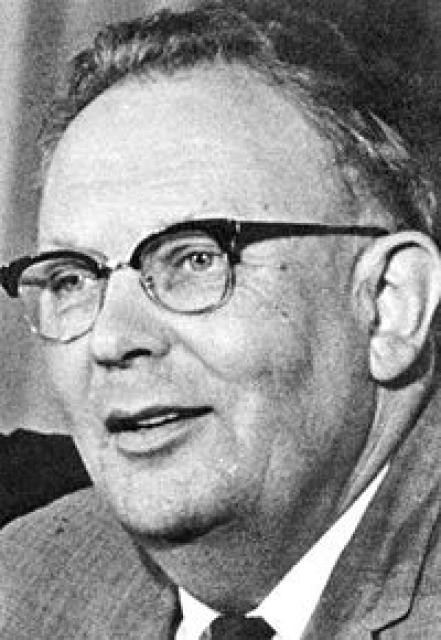
Gerard Peter Kuiper
 USA
USA- Biography of Gerard Peter Kuiper
- Move to the United States
- Contributions to Astronomy
- Accomplishments and Honors
- Death
Biography of Gerard Peter Kuiper
Early Life and EducationGerard Peter Kuiper, a Dutch-American astronomer, was born on December 7, 1905, in Harenkarspel, the Netherlands. He completed his studies at Leiden University at the age of 22, where he worked under the guidance of E. Hertzsprung for six years.

Move to the United States
In 1933, Kuiper relocated to the United States. He worked at the Lick Observatory, as well as the University of Chicago and Harvard University. He later became the director of the Yerkes Observatory. In 1960, he organized the Lunar and Planetary Laboratory at the University of Arizona.
Contributions to Astronomy
Kuiper was a renowned authority in the field of stellar physics. His early scientific works focused on the study of binary stars, leading him to discover numerous new binary stars and white dwarfs. He also authored the concept that more than half of the stars closest to the Sun are part of binary or multiple systems.
In 1937, Kuiper published the first diagram depicting the relationship between the spectrum and luminosity of galactic star clusters. He was the first to spectroscopically detect carbon dioxide in the atmosphere of Mars, discovered the atmosphere of Titan, and identified icy particles in Saturn's rings. He determined the water vapor content in Venus' atmosphere, discovered Uranus' fifth moon, Miranda, and Neptune's second moon, Nereid. Additionally, Kuiper compiled the most comprehensive photographic survey of asteroids.
As one of the leaders in the lunar exploration program, Kuiper discovered the basaltic composition of the lunar maria. He also supervised the lunar photography program from spacecraft.
Accomplishments and Honors
Kuiper compiled an atlas of the infrared solar spectrum and theoretically predicted the existence of a comet belt around the Solar System. This prediction was proven twenty years after his death, and the belt was subsequently named the "Kuiper Belt" in his honor. Several astronomical features, including an asteroid and craters on Mars, the Moon, and Mercury, have been named after him.
Gerard Peter Kuiper was awarded the Janssen Medal by the French Astronomical Society and the Rittenhouse Medal by the National Academy of Sciences in the United States.
Death
Kuiper passed away on December 23, 1973, in Mexico City at the age of 69.


