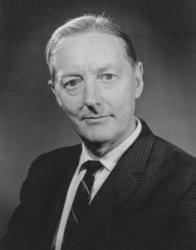
Horace Welcom Babcock
 USA
USA- Horace Welcome Babcock: Pioneering Astronomer
- Research Positions
- Stellar Magnetism
- Solar Magnetism
- Galactic Research
- Instrumentation and Honors
Horace Welcome Babcock: Pioneering Astronomer
Early Life and EducationHorace Welcome Babcock was born in Pasadena, California, the son of the renowned astronomer Harold D. Babcock. Following his father's footsteps, he pursued a career in astronomy, graduating from the California Institute of Technology in 1934 and continuing his studies at the University of California, Berkeley.
Research Positions
Before World War II, Babcock worked at the Lick Observatory (1938-1939) and the McDonald Observatory (1939-1941). During the war, he conducted research on military topics at the Massachusetts Institute of Technology and the California Institute of Technology.
Stellar Magnetism
After the war, Babcock joined the staff of the Mount Wilson and Mount Palomar Observatories, serving as their director from 1964 to 1978. There, he became a pioneer in the study of stellar magnetism. In 1946, he discovered the first magnetic field in a star (78 Virginis) and later found that many other stars had strong magnetic fields. He also invented a Zeeman analyzer to measure these fields accurately.
Solar Magnetism
Babcock collaborated extensively with his father on solar magnetic field research. Together, they developed the solar magnetograph in 1952, enabling them to map the magnetic fields on the Sun's surface. Babcock proposed a hypothesis explaining the formation of sunspots based on the emergence of toroidal magnetic fields.
Galactic Research
Babcock also made significant contributions to the study of galaxies. He observed the rotation of the Andromeda galaxy and noted that its spiral arms were trailing behind the nucleus. He conducted spectroscopic studies of various celestial objects, including U Geminorum-type stars, comets, and the Sun.
Instrumentation and Honors
Babcock was an accomplished instrument designer, creating numerous devices for the Mount Wilson and Mount Palomar Observatories. He invented the first automatic microphotometer, exposure meters, and automatic guiding systems for the observatory's large telescopes. He also designed a machine for ruling diffraction gratings.
Babcock received numerous honors for his contributions, including the Henry Draper Medal (1957), the Eddington Medal (1957), and the Bruce Medal (1969). A crater on the Moon and an asteroid (3167 Babcock) are named after him and his father.