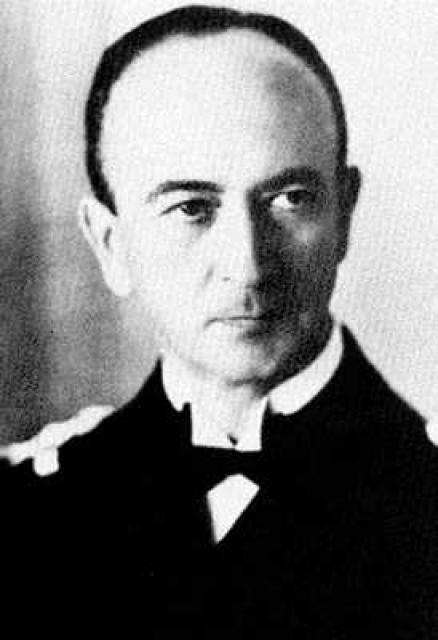
German Bem
 Germany
Biography of Hermann Boehm
Hermann Boehm was born on January 18, 1884, in Rybnik, Upper Silesia. He joined the Imperial Navy as a cadet in 1903. Boehm obtained the rank of lieutenant zur see in 1911 and served as the commander of several torpedo boats until 1918. In 1919, he was dismissed from the fleet but returned a year later and held important positions throughout his career.
Boehm served as the commander of the 2nd Minesweeper-Torpedo Flotilla from 1926 to 1928, the Chief of Staff of Fleet Command from 1932 to 1933, the commander of the battleship "Hessen" from 1933 to 1934, and the commander of the reconnaissance forces and German squadron in Spanish waters during the first year of the civil war from 1936 to 1937. On October 4, 1937, Boehm became the head of the North Sea Naval District. His promotion during the 1920s and 1930s was extremely rapid, as he rose from Corvette Captain to Admiral in just 16 years.
On November 1, 1938, Boehm was appointed as the commander of the fleet, but he did not stay in that position for long. He was relieved of command not because of any mistakes or professional reasons but solely because Admiral Erich Raeder took offense to the wording of an order issued by Boehm's operational officer, which Raeder saw as mocking one of his numerous decisions. Raeder was known to be sensitive to any criticism towards him.
On October 21, 1939, Boehm was replaced by Vice Admiral Wilhelm Marschall, the former commander of raiders. Despite Boehm's expulsion, his abilities were never questioned. After some time, Raeder changed his anger into mercy and appointed Boehm as the commander of the German Navy forces in Norway, and on April 1, 1941, promoted him to the rank of General Admiral.
Boehm held this position until 1943 when he was replaced by Grand Admiral Karl Dönitz due to his lack of faith in National Socialism, his opposition to the measures implemented by Imperial Commissioner Terboven in Norway, and primarily because Dönitz, like Raeder, wanted to remove any senior officer who posed a threat to his own position. General Admiral Hermann Boehm spent a whole year in retirement.
On March 1, 1944, Dönitz appointed Boehm as the Chief Inspector of Naval Training Institutions. Boehm remained in this position until March 31, 1945, when the collapse of the Reich was imminent. On that day, he retired from active service and settled in Kiel, where he passed away on April 11, 1972, at the age of 88.
The case of Hermann Boehm was one of the examples of Admiral Raeder's inability to properly utilize the talents of his subordinates. His insecurity was also evident in the command structure he organized. The fleet commander was theoretically not directly subordinate to Admiral Raeder. Raeder established staffs for the Baltic and North Sea Naval Districts, known as "East" and "West" respectively, which were supposed to coordinate their actions with the fleet commander. However, if the fleet was simultaneously present in both the Baltic and North Seas, its units were supposed to obey the respective district staffs. Later, other naval task forces were created. Raeder further exacerbated the confusion by bypassing the staffs of the naval task forces and thereby violating the chain of command. Often, when the fleet was at sea, its commander received two conflicting orders: one from Raeder and another from the task force staff. Raeder's orders were often vague, and the fleet commander did not always understand what the Grand Admiral wanted. However, it was disastrous for a commander whose actions did not align with Erich Raeder's plans.


