Germogen
 Russia
- Saint Hermogenes
- Rise to Patriarchate
- Early Life and Beliefs
- Religious Zealousy
- Dispute with False Dmitry I
- Conflict with Tsar Shuisky
- Civil War and Resistance
- Opposition to Władysław's Candidacy
- Stand Against Polish Influence
- Exile and Martyrdom
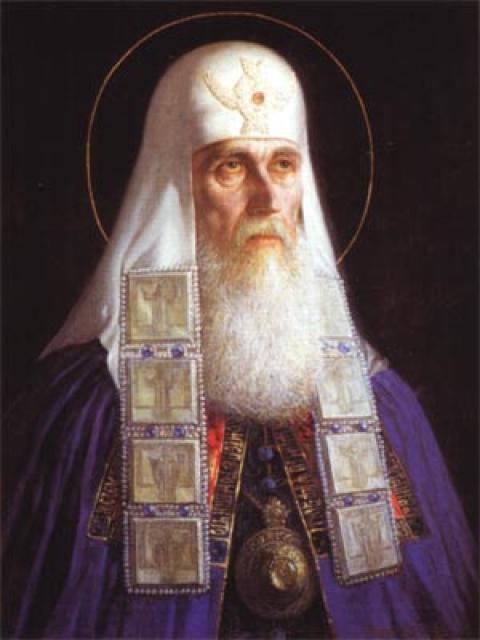
Saint Hermogenes
Hermogenes was an eminent saint, patriarch, and spiritual writer. He played a crucial role in the election of Boris Godunov as tsar and strongly opposed False Dmitry I, demanding the baptism of Marina Mniszech into the Orthodox faith. Consequently, he was exiled.
Rise to Patriarchate
In 1606, under Tsar Vasily Ivanovich Shuisky, Hermogenes ascended to the patriarchate and actively supported the tsar's policies. He sent letters condemning the supporters of Ivan Bolotnikov's rebellion and opposed False Dmitry II in 1608.
Early Life and Beliefs
Little is known about his early years, although Polish commander A. Gonsevsky possessed a written testimony about Hermogenes obtained from a Moscow priest. This account suggested that he had served as a "Don Cossack" in his youth. Hermogenes was first mentioned as a clergyman in his 50s as a priest in a Kazan church. He later became a monk in the same city and eventually the archimandrite of the Spaso-Preobrazhensky Monastery in Kazan.
Contemporary accounts describe Hermogenes as "eloquent and cunning but not sweet-tongued," "coarse in nature," and "stubborn in words and views." Upon the establishment of the patriarchate in Russia (1589), he was consecrated as archbishop and sent to lead the Kazan diocese.
Religious Zealousy
As an ardent advocate of the Orthodox faith, Hermogenes exhibited a fiery zeal to convert non-Russian populations in the Volga region to Christianity. He condemned their perceived pagan practices and demanded their compliance with Orthodox customs. He also protested the construction of Tatar mosques in Kazan, calling for their demolition.
Dispute with False Dmitry I
With the accession of False Dmitry I (1605), a senate was created, which included senior clergy. Hermogenes became a member and was summoned to Moscow. He consistently defended the interests of the Russian Orthodox Church, believing its strength depended on the support of the tsarist power. However, his demand for the re-baptism of Marina Mniszech, a Polish Catholic, angered False Dmitry I, who ordered his exile to a monastery in his diocese.
Conflict with Tsar Shuisky
After the assassination of False Dmitry I, Tsar Vasily Shuisky ascended to the throne (1606). Fearing the ambitions of Filaret (F.N. Romanov), who was poised to claim the patriarchate, Shuisky sent him to the metropolitan see of Rostov and ordered Hermogenes to be consecrated as patriarch. Their relationship soon deteriorated.
While Hermogenes was uncompromising and confrontational, Shuisky was seen as weak and ineffective. Hermogenes ignored the circumstances that made Shuisky's position precarious, adhering strictly to religious formalities.
Civil War and Resistance
During the civil war that ensued (1606-1607), Hermogenes mobilized the church to fight the rebels, declaring them heretics and excommunicating them. On February 17, 1609, a group of conspirators led by G. Sumbilov, Prince R. Gagarin, and T. Gryaznoy attempted to depose Shuisky. Hermogenes, despite his dislike of the tsar, refused to support their cause and was forcibly taken to Lobnoye Mesto. The conspirators demanded his allegiance, but he remained loyal to Shuisky, recognizing his legitimacy as the anointed ruler.
After the failure of the coup, Hermogenes urged those who had joined False Dmitry II in Tushino to repent and return to the authority of Tsar Shuisky. He wrote impassioned letters, pleading with them to abandon their misguided actions.
Opposition to Władysław's Candidacy
When Vasily Shuisky was deposed (1610), Hermogenes defended him, denouncing Z. Lyapunov and his supporters who had forcibly removed the tsar from power. He refused to recognize Shuisky's forced monastic vows as valid. Imprisoned in the Chudov Monastery, Hermogenes continued to insist on Shuisky's reinstatement.
As the throne became a focus of vying contenders, Hermogenes opposed Prince V.V. Golitsyn's pretensions and supported Mikhail F. Romanov's candidacy. However, the majority initially favored Polish prince Władysław.
Hermogenes remained adamant that Władysław would only be crowned if he converted to Orthodoxy. He appealed to Polish King Sigismund III to allow his son to embrace the Russian faith but was met with refusal.
Stand Against Polish Influence
When Władysław's troops approached Moscow and the "Seven Boyars" hesitated to demand his baptism, Hermogenes confronted them fiercely. He warned them against submitting to foreign dominance and urged them to defend the Orthodox faith.
On August 17, 10,000 people swore allegiance to Władysław. The following day, as Władysław entered the Moscow Cathedral, Hermogenes remained defiant. He demanded the king's conversion and threatened eternal damnation to all who violated the Orthodox faith.
Despite his resistance, Władysław entered Moscow with his troops. Hermogenes initially resisted meeting with Polish commander A. Gonsevsky but later agreed under duress. He treated Gonsevsky with contempt, refusing to recognize his authority.
Exile and Martyrdom
As Władysław's demands became more oppressive, Hermogenes refused to submit. He continued to denounce Polish influence and demanded the withdrawal of their troops from Moscow. On December 5, 1610, a group of boyars led by F.I. Mstislavsky confronted Hermogenes and demanded his support for Władysław. He refused, threatening to excommunicate them if they acquiesced to the king's will.
Enraged, M. Saltykov-Krivoy drew his knife and threatened to kill Hermogenes. The patriarch remained unyielding, invoking the power of the cross against the knife and cursing Saltykov.
On March 17, 1612, Hermogenes was starved to death in prison by the Polish garrison. His body was later discovered and enshrined as a relic, symbolizing his unwavering faith and resistance to foreign domination.