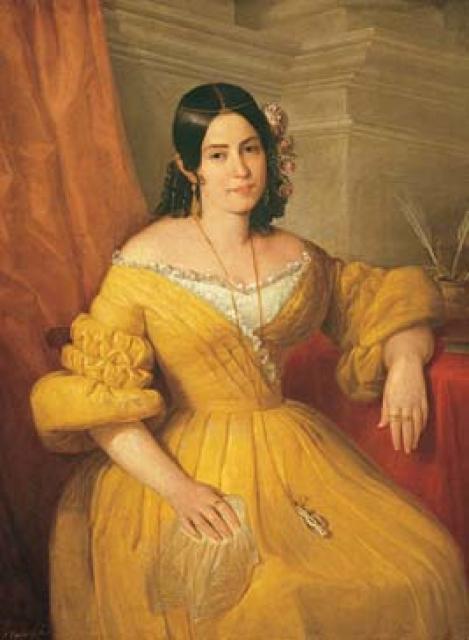
Gertrudis Gomez de Avellaneda
 Cuba
Cuba- Gertrudis Gómez de Avellaneda: Acclaimed Hispanio-Cuban Writer
- Literary Awakening
- Love and Relationships
- Literary Success and Social Activism
- Marriages and Personal Loss
- Her Literary Legacy
- "Leoncia" (drama, 1840): Her debut play that premiered in Madrid.
- Recognition and Criticism
- Later Years and Death
Gertrudis Gómez de Avellaneda: Acclaimed Hispanio-Cuban Writer
Early Life and Family BackgroundGertrudis Gómez de Avellaneda was born on March 31, 1814, in Puerto Príncipe, Cuba. Her aristocratic father, Manuel Gómez de Avellaneda, hailed from Spain, while her mother came from a prominent Spanish family living in Cuba. From a young age, Gertrudis exhibited a keen interest in literature, often staging and performing in plays she had read.
Literary Awakening
After a brief period of societal pursuits, including dance and art, Gertrudis returned to her passion for books. In the aftermath of a failed arranged marriage, she found solace in writing. At the age of 22, she left Cuba for Spain to pursue her literary career.
Love and Relationships
Gertrudis' first significant love affair with Ignacio de Cepeda deeply influenced her writing. She penned numerous love letters and poems inspired by their relationship. However, she was hesitant to marry due to her lack of substantial wealth, despite her aristocratic lineage.
Literary Success and Social Activism
Gertrudis' literary prominence reached its peak in the 1840s-50s, during which she wrote poetry, autobiographies, novels, and plays. Her works often addressed themes of love, gender inequality, and social injustice. She became a prominent figure in movements for the abolition of slavery and the emancipation of women.
Marriages and Personal Loss
In 1846, Gertrudis married writer Pedro Sabater, who passed away from cancer shortly after. She remarried in 1855 to Colonel Domingo Verdugo-y-Massieu and returned to Cuba, where she published the journal "Álbum cubano." After Domingo's death in 1863, Gertrudis returned to Spain.
Her Literary Legacy
Gertrudis' vast literary output included poetry, drama, novels, short stories, and essays. Her most notable works include:
"Leoncia" (drama, 1840): Her debut play that premiered in Madrid.
"Sab" (novel, 1841): A pioneering anti-slavery novel that earned her acclaim and controversy.
"Alfonso Munio" (tragedy, 1844): A historical drama set in medieval Spain.
"Guatimozín" (historical novel, 1846): A novel about the Spanish conquest of Mexico.
Recognition and Criticism
Gertrudis' writings received widespread recognition during her lifetime. However, she also faced criticism from some, particularly male critics, for her outspoken views on social and gender issues. Nevertheless, her work left a lasting impact on Latin American literature and the fight for social justice.
Later Years and Death
In her later years, Gertrudis suffered from diabetes. She passed away on February 1, 1873, in Madrid, Spain, at the age of 58. Her legacy as a trailblazing writer and social activist continues to inspire generations of readers worldwide.


