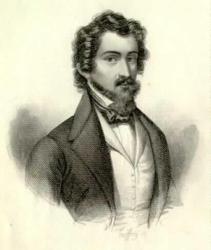
Gesiod
 Greece
Biography of Hesiod
Hesiodos, also known as Hesiod, was an ancient Greek poet born in Askra, Boeotia, around 700 BC. He is considered the second great epic poet of the archaic period, following Homer, and the first known individual in Greek literature. Our knowledge of Hesiod is primarily derived from his own statements in his poems.
Hesiod's father was a merchant in Kyme in Asia Minor, but he abandoned his trade and moved to Greece, where he purchased land in the Boeotian village of Askra. Upon his father's death, Hesiod and his brother Pers divided the estate between them. Dissatisfied with his portion, Pers dragged Hesiod into a long and costly legal battle for a new division of property. In an attempt to dissuade his brother from the lawsuit and encourage him towards honest work, Hesiod wrote the epic poem Works and Days, addressed to Pers.
Hesiod spent his entire life in his hometown, working the fields and performing as a poet for the people. However, there are mentions of his journey to Chalcis on Euboea, where he won a bronze tripod in a poetic competition and dedicated it to the Muses of Helicon. Hesiod died in Askra and was buried in the agora of the Boeotian city of Orchomenos.
Hesiod was the first and possibly the only Greek poet who was also a farmer. He was not a self-taught or natural talent, but rather he used dactylic hexameter, wrote in the Homeric dialect, and borrowed his poetic technique from wandering rhapsodes, who likely taught him the art of poetry.
In the beginning of his Theogony, Hesiod recounts an encounter with the Muses while tending his sheep on the slopes of Mount Helicon. They presented him with a laurel branch and declared him a poet, urging him to sing about the past and the future. The Muses revealed that they speak many lies resembling truth but have the ability to reveal the truth when they wish. This can be interpreted as a critique of the heroic epic, which contains beautiful fiction, and as the main commandment of the new didactic epic, which should proclaim the truth.
Hesiod created didactic epic and its variant, genealogical epic. His earliest known work is Theogony, a "genealogy of the gods" in which he attempted to gather and organize all Greek beliefs about the creation of the world, gods, and heroes. Although he borrowed much from the mythology of the Near East, especially the myth of the succession of ruling gods (Uranus-Cronus-Zeus), he gave it a different form, describing how everything leads to the dominion of Zeus, which the poet identifies with the final establishment of cosmic order.
The Theogony begins with an elaborate proem (lines 1-116), consisting of three parts preceded by invocations to the Muses. The central part of the Theogony (lines 117-964) narrates the creation of the world from Chaos (which for Hesiod is simply a vast abyss), from which emerged first Gaia (Earth), Uranus (Sky), Tartarus (Underworld), and simultaneously the elements and divine beings, as well as Eros, the driving force of all development and reproduction. From the union of Uranus and Gaia, many generations of Titans were born, including Cronus and Rhea. The old and new generations engaged in a bloody battle, which was repeated in the following generation between Cronus and his son Zeus. As a result of this conflict, Zeus stripped the Titans of their power and himself, along with his brothers, took control of the world. Zeus' dominion was wise and just. Eventually, Zeus became the father of gods and men. In Hesiod's work, the gods lost the carefree and jovial nature of the Homeric gods and became moral forces, stern guardians of order and justice, born from Zeus.
Hesiod also wrote a series of Eoia (Catalogues), which were highly popular and considered to be entirely his work, although they included non-Hesiodic excerpts added later to prove the sacred origins of various aristocratic families. One such non-authentic Eoia is the Shield of Heracles, a 480-line poem that tells of Zeus' love for Alcmene and the struggle between his son Heracles and Cycnus. Only small fragments of the full Eoia have survived, but new fragments have been published from papyri.
Works and Days, a didactic epic addressed to Pers, has a free and unstructured composition that is completely different from the orderly structure of Homeric poems. Hesiod appears as a narrator in his poem, speaking about himself and sharing his views with others, primarily his brother. The purpose of Hesiod's work was to convince Pers that the path to improving his financial situation lay in honest work on their ancestral land, rather than pursuing lawsuits and bribing judges. The poem presents a depiction of a world governed by Zeus, a just and wise ruler. From this perspective, Hesiod defines the place of humans, emphasizing the duty of honest labor. The various episodes in Hesiod's seemingly disordered poem are all subordinate to its main didactic purpose: the proem addressed to Zeus, the guardian of justice; the story of the two goddesses Eris (Strife), one benevolent and calling for competition, the other malicious and inciting discord; the myth of Prometheus and Pandora's box, explaining the causes of the current state of affairs; and finally, the narrative of the five ages of humanity, filled with deep pessimism.
Hesiod also wrote the first fable about unjust kings and judges, the story of the hawk and the nightingale, which illustrates the cruel power of the mighty over the talented but weak poet. It serves as a warning that justice prevails over unjust judges, as Zeus punishes the wicked and bestows favor upon the righteous.
Hesiod's work also includes a calendar of agricultural tasks. Based on his own experience, Hesiod lists the work that needs to be done, establishing the order and timing of each task. This part of the poem, which depicts the caring farmer in harmony with nature, possesses high poetic qualities. Hesiod's strong connection to the land, nature, and the rhythms of life is evident. The descriptions of primitive agricultural tools and their use are interesting. The portrayal of rural life feels authentic and vivid, although the remarks about navigation following the calendar are more schematic and reflect the peasant's dislike for the sea. At the end of the poem, there is a list of lucky and unlucky days, which is recognized as a later addition. Hesiod's teachings are typical of a farmer from Boeotia, which was one of the most backward regions of Greece at the time. The power belonged to the aristocracy, and the villages were overcrowded. The fragmentation of land plots increased as Boeotia did not participate in colonization, which temporarily solved this problem in other regions. Hence, Hesiod's characteristically pessimistic view saw no progress in history but rather a gradual decline (the story of the five ages). Hesiod is also attributed with a work called Chiron's Testament (Cheironos hypotekai), a collection of moral precepts pronounced by the centaur Chiron, the tutor of Achilles.
Ancient writers placed Hesiod alongside Homer, considering them both to be the teachers of the Greeks. Herodotus stated that Homer and Hesiod created the Greek gods for the Greeks. Hesiod's reputation is further illuminated by the work Contest of Homer and Hesiod (Agon Homeru kai Hesiodu), often cited under the Latin title Certamen. The existing manuscript version dates back to the 2nd century AD, but a papyrus fragment from the 3rd century BC proves that the story was already known in the early Hellenistic period. Some scholars believe that it originated even earlier, in the classical period. According to the Contest, Homer and Hesiod met in Chalcis on Euboea at a competition in honor of Amphidemus, who died in the so-called Lelantine War (Hesiod indeed participated in these competitions, as he himself mentions in Works and Days). Each poet read what he considered the most beautiful of his works. The brother of the deceased, Panid, awarded the prize to Hesiod for his description of the toil of the farmer, stating that the one who is drawn to labor deserves reward, not the one who glorifies war and slaughter. However, the aristocratic community favored Homer, who presented a battle scene from the Iliad. They criticized Panid's opinion, and from then on, the expression "voice of Panid" came to mean a foolish decision. In Sparta, Hesiod was also considered a poet who was only good for the helots.
Despite some unfavorable judgments, Hesiod remained popular throughout the centuries, and his quotes can be found in the works of the most outstanding Greek poets. His chain composition style was inherited by the Alexandrian poets, such as Callimachus, and influenced authors of didactic poems, such as Aratus, Nicanor of Colophon, and Virgil. In modern times, Hesiod has become a symbol of a new realistic perspective on the ancient world and a growing interest in the everyday lives of ordinary people. This alternative image of antiquity has been called the "Hesiodic aspect of antiquity."