Gilles De Rais
 France
Biography of Gilles de Rais
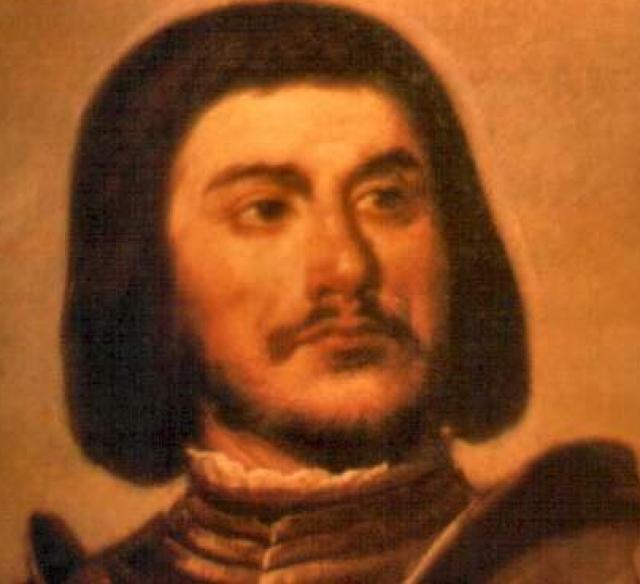
Gilles de Montmorency-Laval, known as Gilles de Rais or Gilles de Retz, was a French baron from the Monmorency-Laval family. He was born in 1404 in the family castle in Machecoul, France to Guy de Laval-Montmorency and Marie de Craon. Gilles was a bright child, fluent in Latin, and received education in both military disciplines and moral/intellectual development.
After the death of his parents in 1415, Gilles and his younger brother René de la Suze came under the guardianship of their maternal grandfather, Jean de Craon. The scheming grandfather attempted to arrange a marriage between the 12-year-old Gilles and the 4-year-old Jeanne Paynel, one of the wealthiest brides in Normandy. When this plan failed, he also tried to marry Gilles to Béatrice de Rohan, the niece of the Duke of Brittany, but this was also unsuccessful. However, on November 30, 1420, Craon significantly increased Gilles' wealth by marrying him to Catherine de Thouars, the heiress of Vendée and Poitou. They had one child, Marie, born in 1429.
From 1427 onwards, Gilles participated in the Hundred Years' War between England and France. He served as a mentor and bodyguard to Joan of Arc. However, when Gilles received a "divine revelation," he became aware of his heavenly destiny and began to display extreme cruelty towards his enemies. At the age of 25, he was granted the title of Marshal of France. But after a series of defeats and a failed attempt to save Joan of Arc from burning at the stake, Gilles retreated to his estate and engaged in internal conflicts with de Bueil.
Shifting his focus away from military affairs, Gilles de Rais spent a considerable amount of his wealth promoting Joan of Arc's fame, including staging a theatrical production called the "Orléans Mystery" which he financed for ten years. From around 1432, Gilles' reputation at the court of King Charles VII became unfavorable due to spreading rumors about his immoral behavior that contradicted Catholic moral norms. In 1433, the marshal retired and settled in his local castle of Tiffauges, where he began experimenting with occult sciences under the guidance of a necromancer named Francesco Prelati. With Gilles, a group of dream interpreters, magicians, sorcerers, and alchemists appeared. Supported by Gilles, who converted large rooms on the ground floor of Tiffauges into an alchemical laboratory, the alchemists searched for the Philosopher's Stone and attempted to transform base metals into gold.
Prelati, who possessed the gift of persuasion, gained special favor with Gilles by allegedly showing him a demon named Baron during spiritual sessions, who demanded children as sacrifices in exchange for the ability to communicate with the world of the dead. According to Gilles' confession, he first attacked children between the spring of 1432 and the spring of 1433. The first murders took place in Champtocé, after which Gilles de Rais sexually assaulted and killed an indefinite number of children. In 1437, the bodies of 40 victims were discovered in Machecoul. In his biography of Gilles in 1971, Jean Benedetti describes how the children in Rais' hands met their deaths: "They pampered the boy, dressed him in the best clothes he could see. The evening began with a big feast and a large amount of drinks, especially hippocras, which excited (the baron). The boy was brought to the upper room, where only Gilles and his closest circle could enter. And there he learned the true nature of his situation. His shocked state was the first source of pleasure for Gilles."
Later, it was revealed that sodomy with minors was not the most important aspect for Gilles de Rais. With many of them, he was satisfied with masturbation, but he derived significant pleasure from watching their heads slowly detach from their bodies. He was irritated by the screams of the children, which could deprive him of his erection, so he would tie a rope around their necks and hang them in a corner of the room. On September 13, 1440, without resistance, Gilles appeared in court at the summons of a bishop, which took place in the bishop's residence. The baron considered the trial unlawful, stating that he would rather go to the gallows because all the accusations were lies and the judges were simoniacs and villains. Of all the charges brought against de Rais, he only confessed to reading a book on alchemy. However, he denied "persistent heresy," connection with the demon, and making a pact with Satan.
In the torture chamber, designed to "end the detestable denial," the stretched-out marshal quickly requested the cessation of torture. He promised to confess "voluntarily and freely" to everything. Gilles recounted how he "enjoyed vice," removing children's heads with his own hands. According to him, there were about 800 victims, but the court, relying on the testimony of the most important witnesses, settled on a figure of 150 victims. Charged with apostasy, heresy, summoning demons, sodomy, blasphemy, and desecration of church privileges, Gilles de Rais was handed over to the secular authorities by the decision of the ecclesiastical court. The civil court accused him of murder, which the ecclesiastical court could not do. On October 25, 1440, Rais was "expelled from the bosom of the Christian church," while the chancellor of the Breton Parliament sentenced him to be burned at the stake.
On October 26, 1440, the repentant serial killer addressed the crowd and was given the right to be strangled with a garrote before being thrown into the fire, which somewhat eased his suffering. The charred body was given to his cousins and nephews since Joan of Arc's relatives did not wish to take his coffin to the family tomb.
Today, the opinions of researchers about Gilles de Rais' guilt or innocence are divided.