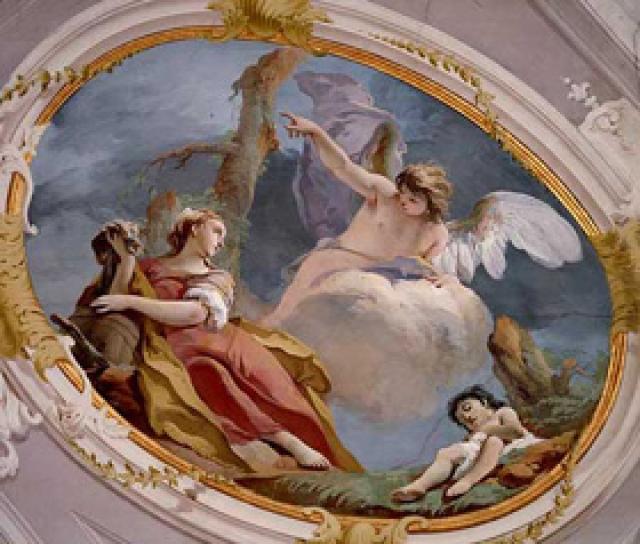
Giovanni Battista Tiepolo
 France
Biography of Giovanni Battista Tiepolo
Giovanni Battista Tiepolo (1696–1770) was an Venetian painter, draftsman, and engraver. He was born in Venice in March 1696 and studied under Gregorio Lazzarini. His early works were influenced by his contemporary Giambattista Piazzetta, characterized by a dark color palette and sharp contrasts of light and shadow.
Career and Style
Tiepolo developed his own style, combining elements of Roman Baroque and Venetian colorism. His paintings were grand and effortless, decorative and elegant. Some of his early works in the Venetian Rococo style include the ceiling frescoes "Madonna with Rosary" (1739, Venice, Church of the Gesuati) and "The Translation of the House of the Virgin" (1743-1744, Venice, Church of Santa Maria dei Scalzi). These frescoes featured a deep sense of space created by numerous figures depicted from various angles, giving the impression of soaring into the heavenly heights.
Tiepolo's reputation quickly spread beyond Venice. Between 1726 and 1761, he received various commissions to decorate churches and palaces in Udine, Milan, Bergamo, Vicenza, and Verona. In 1750, he was invited by the Archbishop of Würzburg to Bavaria, where he and his sons painted the throne room and ceiling frescoes in the Archbishop's palace. Upon returning to Venice in 1758, Tiepolo was elected as the first president of the Venetian Academy of Fine Arts. In 1762, he was invited by King Charles III to Madrid, where he and his sons again worked together to decorate the new royal palace.
Tiepolo continued to work until his death on March 27, 1770. His easel paintings are relatively few in comparison to his drawings, which were collected and preserved by his friend, Count Algarotti. Tiepolo was also a brilliant etcher, and his most famous etching series include "Vari Capricci" (various whims) and "Scerzi di Fantasia" (fantasy jokes).
Legacy
One of Tiepolo's sons, Lorenzo (1736–1776), continued to work in Madrid in the same Rococo style even after his father's death. His other son, Giovanni Domenico (1727–1804), returned to Venice and his works had a more restrained and neoclassical style.