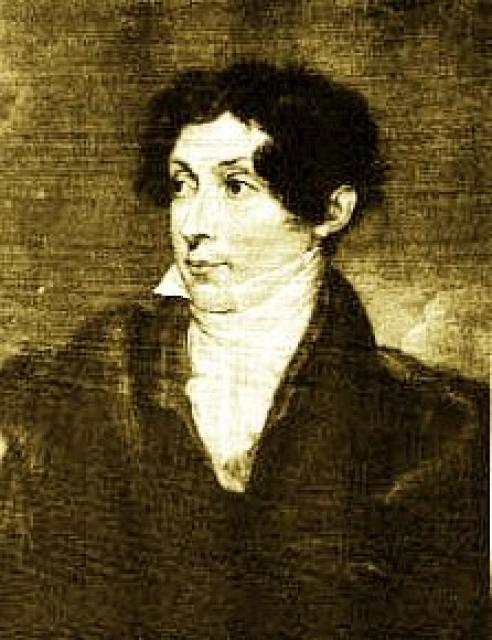
Giovanni Battista Velluti
 Italy
Giovanni Battista Velluti was one of the last great castrato singers to command an international operatic career. Celebrated for a powerful high voice, expressive phrasing and elaborate ornamentation, he performed across Europe and inspired roles by Gioachino Rossini and Giacomo Meyerbeer. His life bridged two eras: he carried the heroic castrato tradition onto the Romantic opera stage even as audiences and composers moved toward new vocal ideals.
Early life and rise
Velluti was born on January 28, 1780, in Montolmo, now called Corridonia, near Macerata in central Italy. Little is known with certainty about his musical training. His first documented performance took place in 1797, and he soon appeared in major theatres in Rome and Naples, taking leading male roles in operas by composers including Domenico Cimarosa, Giovanni Paisiello and Giuseppe Nicolini.
His career expanded rapidly. In 1808 he made his debut at Milan’s Teatro alla Scala, and subsequent engagements took him to Vienna, Venice and Munich. He developed a lasting artistic partnership with Nicolini, whose operas Velluti championed in Italy and abroad. He was also an active musical professional beyond the stage, working as a director, impresario and singing teacher.
Rossini, Meyerbeer and the London stage
In December 1813, Velluti created the role of Arsace in Rossini’s Aureliano in Palmira at La Scala. It was the only principal castrato role Rossini wrote. The opera did not succeed at its premiere, and Velluti and the composer did not work together on another opera. Later stories claimed that Rossini was angered by Velluti’s extensive embellishments. Accounts of the collaboration are more nuanced: the singer’s improvisational freedom belonged to an operatic culture in which leading performers were expected to personalize repeated musical passages.
Velluti’s most famous role was Armando in Meyerbeer’s Il crociato in Egitto, which premiered in Venice in 1824. The opera became an international success and brought him to London the following year. His appearance at the King’s Theatre attracted intense attention. Some British commentators resisted the return of a castrato to the opera stage, while audiences were impressed by his vocal control and dramatic presence. At the Royal Academy of Music, he also taught singing, and in London he took on practical responsibilities for productions, including work with the cast and staging.
Later years and legacy
After his London seasons, Velluti’s stage appearances became less frequent. He continued to perform in Italy and gave his final operatic performances in 1833. He then retired to his villa at Sambruson near Venice, where he continued to teach and stayed connected to musical life.
Velluti died on January 22, 1861, six days before his 81st birthday. No recording preserves his voice, but the roles written for him and contemporary accounts of his performances offer a record of his artistry. His career is a vivid link between the age when castrati embodied operatic heroism and the nineteenth-century shift toward the tenor as the leading male voice. Remembered as a musician and theatrical figure in his own right, he was more than a symbol of a disappearing tradition.