Gomer
 Greece
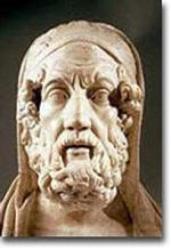
Homer stands at the beginning of the Western epic tradition, yet he is also one of its most elusive figures. Ancient Greeks credited him with two immense poems, the Iliad and the Odyssey, and later readers treated him as the great poet who had given their culture its heroic past. But the evidence for the man himself is scarce. His birthplace, lifetime, and even the precise nature of his role in shaping the poems remain uncertain.
A poet hidden behind tradition
Homer was probably active in the early archaic period of Greek history, often placed around the eighth century BCE, though no secure date survives. Ancient writers associated him with cities in Ionia, the Greek-speaking settlements on the western coast of what is now Turkey, and some traditions called him blind. These details belong to competing ancient biographies written centuries after the poems took shape. They offer a glimpse of how later Greeks imagined their poet, but they cannot be treated as a reliable personal record.
The central question is whether “Homer” names a single historical poet, a master singer who shaped inherited material, or a figure attached to a long tradition of epic performance. Scholars continue to debate the process by which the Iliad and Odyssey reached their surviving forms. What is clear is that both poems grew out of a living oral culture in which singers performed and recomposed epic verse before audiences.
The language of the poems preserves traces of that long history. Their Greek is a poetic blend of dialects and forms from different periods, shaped for verse and performance rather than ordinary conversation. Repeated phrases, scenes, and descriptive formulas helped singers compose in the demanding rhythm of dactylic hexameter. Over time, performance and textual transmission carried the poems across the Greek world.
The Iliad and the Odyssey
The Iliad focuses on a brief, devastating episode near the end of the Trojan War: the anger of Achilles and its cost to the Greek army. Rather than narrating the entire war, it concentrates on rage, honor, grief, friendship, and the vulnerability shared by heroes and their enemies. Its battlefield scenes are vivid, but some of its most enduring moments turn toward compassion, especially when the Trojan king Priam comes to Achilles to ask for his son Hector’s body.
The Odyssey follows a very different path. After the fall of Troy, Odysseus struggles for years to return to Ithaca, where his wife Penelope and son Telemachus face the pressure of suitors who believe he will never come home. The poem moves through shipwrecks, monsters, divine interventions, and tales of cunning. At its heart is the difficult work of survival and recognition: Odysseus must find his way home, and those he loves must discover who he has become.
Together, the epics create a world populated by gods, kings, warriors, servants, and families. The divine and human realms continually intersect, but the poems are not simple celebrations of strength. They ask what war costs, how people endure loss, and what makes a life honorable. Their emotional range—from the spectacle of battle to the quiet tension of a homecoming—helped give them a reach far beyond the society that first performed them.
A lasting cultural force
In antiquity, Homer’s poems served as more than entertainment. Greek audiences learned stories, values, and models of speech from them; rhapsodes recited epic at festivals and public gatherings. Their influence spread through education, drama, philosophy, and visual art. Roman poets, especially Virgil, responded directly to the Homeric tradition, and later European writers repeatedly returned to its themes and forms.
The poems also became a meeting point for scholarship. Ancient editors and commentators worked to establish and explain their texts, while modern scholars investigate how oral performance, writing, and revision shaped them. The Homeric Question—how many hands and stages lie behind the epics—has no simple answer. That uncertainty has not diminished their power. It has made the poems’ history part of their fascination.
Homer may remain beyond the reach of conventional biography, but the works associated with his name have proved remarkably durable. Across centuries, the Iliad and the Odyssey have continued to invite readers into a world of conflict, longing, courage, and homecoming. Their legendary poet is hard to pin down; his cultural presence is impossible to miss.