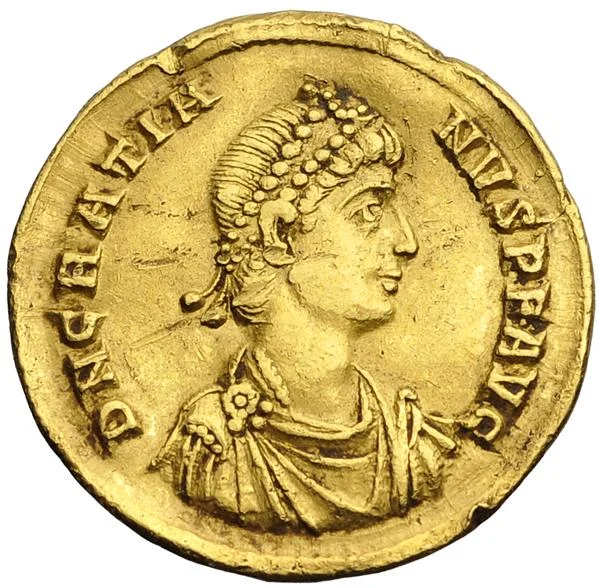
Gratian
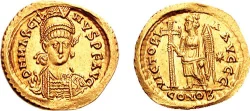
Gratian became a Roman emperor while still a child and inherited a western empire facing pressure on its frontiers and deepening religious divisions. His reign included a notable military victory, an important shift in the balance of imperial power after the Battle of Adrianople, and a growing alignment of the western court with Nicene Christianity. He was overthrown before reaching 25.
A young emperor
Gratian was born on 18 April 359 at Sirmium, in the Roman province of Pannonia. His father was Valentinian I, a career soldier who became emperor in 364. In 367, when Gratian was only eight, Valentinian elevated him to the rank of Augustus and co-emperor. The appointment secured a dynastic successor, though the child was initially too young to govern independently.
When Valentinian died in 375, Gratian assumed leadership in the western provinces. His four-year-old half-brother, Valentinian II, was also proclaimed emperor by the army in Italy, creating a divided arrangement in which both boys held imperial titles. Advisors and military commanders played major roles, but Gratian gradually exercised authority in his own right.
War, religion, and the eastern empire
In 378, Gratian defeated the Alemanni near Argentovaria, in a campaign that demonstrated his ability to lead troops. He was moving east to support his uncle, Emperor Valens, when news arrived that Valens and much of the eastern field army had been destroyed by the Goths at Adrianople. Unable to manage the pressures on both halves of the empire alone, Gratian appointed the experienced general Theodosius as emperor in the East in 379.
Religion also shaped his reign. Gratian favored Nicene Christianity and worked closely with influential church leaders, including Ambrose, bishop of Milan. He withdrew certain forms of public support and privileges from traditional Roman cults, a move that sharpened disputes over the place of pagan worship in civic life. His religious policies became part of a broader transformation that continued under Theodosius.
Revolt and death
Gratian’s rule faced another challenge in 383, when troops in Britain proclaimed Magnus Maximus emperor. The rebellion rapidly spread into Gaul, and Gratian’s forces deserted or joined the challenger. Gratian fled south but was captured and killed at Lugdunum, modern Lyon, on 25 August 383. He was 24.
His death opened the way for Maximus to rule much of the West, while Valentinian II retained Italy with the support of Theodosius. Gratian’s legacy is difficult to separate from the pressures of child emperorship and a fragmented imperial system. He was remembered as a committed Christian ruler, but his defeat also revealed how quickly loyalty among the army could determine who held the throne.