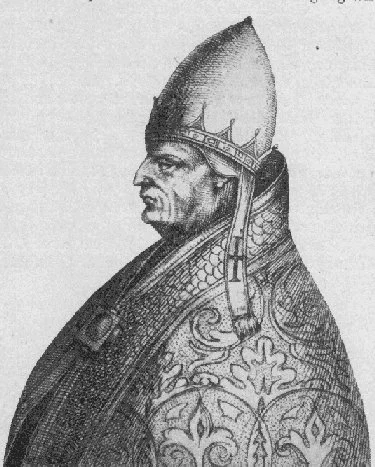
Gregory VI
Gregory VI, born John Gratian, was pope from 1045 to 1046, during one of the most chaotic periods in the medieval papacy. He came to office after Pope Benedict IX resigned in a controversial transaction that contemporaries and later church authorities treated as simony. Gregory was regarded by some reformers as a serious attempt to restore order, but his compromised election became the central issue of his brief pontificate.
Election amid papal disorder
Little is known about John Gratian’s early life. He was a Roman priest and archpriest of San Giovanni a Porta Latina. In 1044, a faction of Roman nobles drove Benedict IX from the city and installed John, bishop of Sabina, as Pope Sylvester III. Benedict later returned to Rome, but in 1045 he relinquished the papacy to Gratian.
Gratian took the name Gregory VI and was elected on 1 May 1045. Accounts describe a payment to Benedict IX in connection with his resignation. Gregory’s supporters may have seen the arrangement as a way to remove a discredited pope and stabilize the Church; church reformers considered the transaction simony, the buying or selling of ecclesiastical office. With Benedict and Sylvester still advancing claims, Gregory’s legitimacy remained contested.
Council of Sutri and resignation
In 1046, Henry III, king of Germany, crossed into Italy to address the divided papacy and secure an orderly imperial coronation. Gregory met him and convened a council at Sutri on 20 December. The council deposed Sylvester III and heard Gregory’s acknowledgment that his election had involved an unlawful transaction. He resigned the office.
A further council in Rome deposed Benedict IX, and Henry’s support helped install Suidger of Bamberg as Pope Clement II. The intervention demonstrated how strongly the German king could shape papal politics at the time. Gregory accepted the outcome and accompanied the reform-minded cleric Hildebrand, later Pope Gregory VII, into exile.
Exile and legacy
Gregory VI was sent north of the Alps and probably died in Cologne around 1047 or 1048. The exact date and circumstances of his death are uncertain. His papacy lasted about nineteen months, and he left no long-lasting institutional program of his own.
His short reign stands at the beginning of the eleventh-century reform movement that sought to free the Church from the sale of offices and outside political control. Gregory’s reputation is complicated: he may have intended to end a scandalous situation, yet the means by which he became pope undermined his authority. The Council of Sutri marked a turning point in the struggle over who could legitimately choose and remove a pope.


