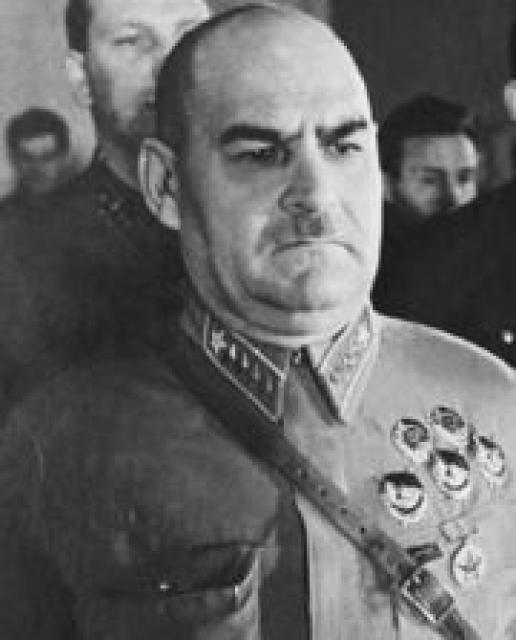
Grigoriy Kulik
 Ukraine
- Biography of Grigory Kulik
- Early Career and Leadership
- Controversies and Challenges
- World War II and Downfall
- Later Years and Rehabilitation
Biography of Grigory Kulik
Grigory Kulik was a Soviet military commander and Marshal of the Soviet Union. He was born in a peasant family near Poltava in Ukraine. Kulik began his military service in the Tsarist army during World War I. He joined the Bolshevik Party in 1917 and the Red Army in 1918. During the Civil War, he served as an artillery commander and participated in battles near Kharkov and other engagements.
Early Career and Leadership
In 1926, Kulik became the Chief of the Artillery Directorate of the Red Army and remained one of the leaders of the artillery until 1941. He opposed the radical reforms proposed by Mikhail Tukhachevsky in the 1930s, which ultimately saved him from the Stalinist purges of the Red Army in 1937-38. In 1939, he became the Deputy People's Commissar of Defense and also took part in the Soviet invasion of Poland in September 1939. He later commanded the artillery during the Soviet-Finnish War in the early winter.
Controversies and Challenges
Kulik had a reputation as an incompetent officer and a troublemaker, but his loyalty to Stalin protected him from criticism. In May 1940, his wife, Kira Simonich, who was of Jewish nationality, disappeared without a trace just two days before Kulik was appointed as a Marshal of the Soviet Union. He resisted Semyon Timoshenko's campaign for the mechanization of the Red Army and the use of minefields as "weapons of the weak". This conservative resistance cost the Soviet Union dearly. Kulik also underestimated the role of automatic firearms in modern warfare, referring to submachine guns as "police weapons" due to their relative inaccuracy, limited range, and high ammunition consumption.
World War II and Downfall
In June 1941, after the German invasion, Kulik was sent to assist the command of the Western Front but became encircled with the 10th Army and only managed to escape after several weeks. In September 1941, he took command of the 54th Army, with the task of breaking the blockade of the Leningrad Front from the outside. However, his incompetence led to heavy Soviet defeats and ultimately to the encirclement of Leningrad. In February 1942, he was brought to trial for leaving the Kerch Peninsula without orders, stripped of awards, demoted to the rank of Major General, and removed from the Central Committee.
Later Years and Rehabilitation
In April 1943, Kulik became the commander of the 4th Barrier Army but was soon relieved of his duties due to his incompetence. From 1944 to 1945, he served as the Deputy Chief of Mobilization and the Deputy Commander of the Volga Military District. In April 1945, he was again demoted to the rank of Major General due to the collapse of combat readiness and "moral decay". After a brief respite following the war, Stalin initiated a new cycle of purges. In 1946, Kulik was removed from all positions, arrested on January 11, 1947, and executed in 1950, along with Generals V.P. Gordov and F.T. Rybalchenko, "accused of organizing a conspiratorial group against Soviet power". He was reported to have spoken disrespectfully about the party and Stalin during drunken conversations. The true reasons for his demise remain unclear. However, on April 11, 1956, he was rehabilitated by N.S. Khrushchev, and in 1958, he was posthumously restored to the rank of Marshal of the Soviet Union (although at the time of his execution, he was a Major General, and he was not rehabilitated for the 1942 case).



