Gudea
Gudea ruled the Sumerian city-state of Lagash in southern Mesopotamia in the late third millennium BCE. Known chiefly through his inscriptions and numerous surviving statues, he presented himself as a pious ruler devoted to restoring temples and maintaining the worship of the city’s gods. His accounts of building projects, especially the temple of Ningirsu, make him one of the best-documented rulers of his era.
Ruler of Lagash
Gudea held the title ensi, often translated as “ruler” or “governor,” of Lagash. His reign is usually placed around 2144–2124 BCE, though dates and chronology vary among scholars. Lagash was a network of urban centers in southern Mesopotamia, including Girsu, where many of Gudea’s monuments and inscriptions were found.
Unlike royal inscriptions that emphasize military conquest, many texts from Gudea’s reign focus on ritual, temples and offerings. They portray the ruler as responsible for restoring sacred buildings and ensuring proper relations between the city and its deities. This emphasis reflects both Gudea’s own royal image and the political and religious values of Lagash.
The temple of Ningirsu
Gudea’s most famous project was the rebuilding of Eninnu, the principal temple of Ningirsu, the patron god of Lagash. Two long clay cylinders describe the project in Sumerian. Their narrative recounts a dream in which the god instructed Gudea to build the temple, the ruler’s search for the meaning of the dream, and the subsequent construction and dedication.
The inscriptions record the movement of materials from distant regions, including timber, stone and metal, showing the networks of trade and labor available to the ruler. Gudea also built or restored sanctuaries for other deities in the region, including Bau and Ningishzida.
Statues and royal image
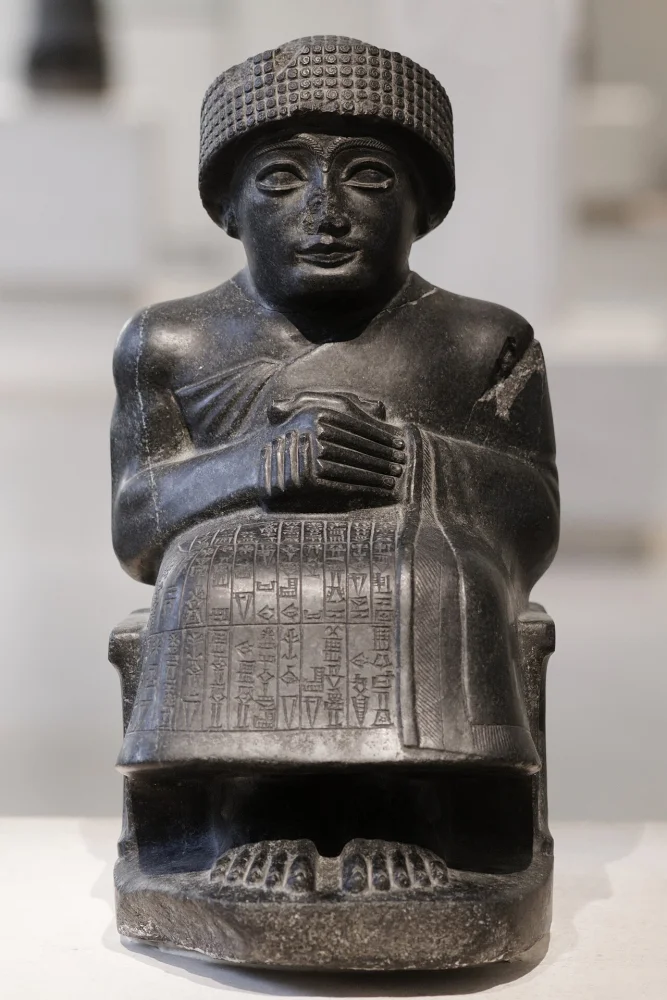
A series of seated and standing statues depicts Gudea in a calm, attentive posture, often with clasped hands and a rounded cap. Many are carved from hard dark stone, including diorite, and carry cuneiform inscriptions naming the ruler, the temple and the deity to whom the statue was dedicated.
The statues were not simply portraits for display. Inscriptions indicate they were placed in temples, where the ruler’s image could remain present before the gods. Some show Gudea holding a plan or tablet associated with a building project, reinforcing the image of a ruler who personally oversaw sacred construction.
Legacy
Gudea’s monuments and texts preserve an unusually detailed view of Sumerian kingship, religion and building practice. The surviving inscriptions provide information about temple ritual, regional trade and the ruler’s public image, while the statues remain among the most recognizable works of ancient Mesopotamian sculpture.
His legacy rests on a distinctive model of authority: the ruler as builder and servant of the gods. Through carefully crafted texts and images, Gudea made temple restoration the central achievement of his reign and left a record that continues to shape modern understanding of Lagash.