Pachacútec
- From Cusi Yupanqui to Pachacútec
- Building an empire from Cusco
- Architecture, religion, and royal estates
- Legacy
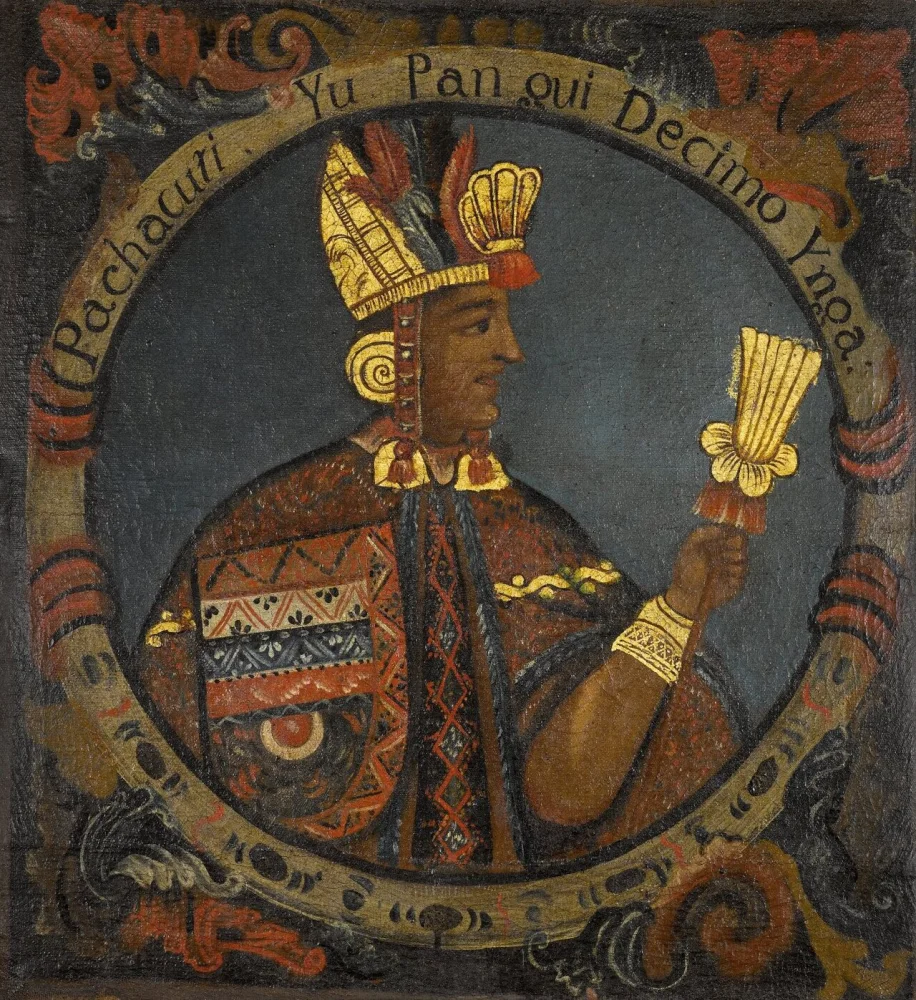
Pachacútec Inca Yupanqui transformed the small kingdom centered on Cusco into the foundation of the Inca Empire, known in Quechua as Tawantinsuyu. Traditionally dated to about 1438–1471, his reign began with a crisis: the Chanka people threatened Cusco, and later accounts say that the young prince Cusi Yupanqui organized the city’s defense after his father withdrew. His victory was followed by territorial expansion, a redesigned capital, and an administrative system that connected distant communities to the Inca state.
From Cusi Yupanqui to Pachacútec
Pachacútec was born Cusi Yupanqui, the son of Viracocha Inca, ruler of the Cusco kingdom. The details of his rise come mainly from Spanish writers who recorded Inca histories after the conquest, drawing on oral accounts and traditions that did not always agree. The precise dates of his reign are therefore debated, though 1438 to 1471 is the chronology most often used.
According to those accounts, a Chanka force advanced on Cusco while Viracocha and his preferred successor retreated. Cusi Yupanqui rallied the city’s defenders and defeated the attackers. After the victory, he took power and adopted the name Pachacútec, commonly understood as “world-changer” or “earth-shaker.” The episode became a foundational story for the imperial dynasty, presenting his leadership as the moment when Cusco began to rise beyond its valley.
Building an empire from Cusco
Pachacútec led campaigns that extended Inca influence across neighboring regions. He and his successors brought territories into a growing state through warfare, alliances, and political negotiation. His son Topa Inca Yupanqui continued the expansion, campaigning farther north and south as Pachacútec consolidated authority around the capital.
The ruler also reshaped Cusco. He is credited with rebuilding the city according to a deliberate plan and strengthening its role as the symbolic center of the empire. Tawantinsuyu, meaning “the four parts together,” was organized around four major regions radiating from Cusco. The capital’s layout and ceremonies reinforced the idea that the ruler stood at the center of a vast, connected realm.
Roads, bridges, relay stations, and storehouses helped move armies, officials, goods, and messages through difficult Andean terrain. These networks relied on state labor obligations imposed on households, while administrative centers coordinated local populations and resources. The system made communication and provisioning possible over great distances, but it also placed significant demands on communities absorbed into the empire. In some regions, the state relocated groups to consolidate control and redistribute labor.
Architecture, religion, and royal estates
Pachacútec’s reign is associated with major building projects in and around Cusco, including the reconstruction of the city’s ceremonial core and the Temple of the Sun, Qorikancha. Architecture and religious observances helped express the authority of the ruler, who was closely linked to the sun deity Inti in imperial ideology.
Machu Picchu, built in the fifteenth century above the Urubamba River, is widely understood as a royal estate associated with Pachacútec and his lineage. Its terraces, residences, ceremonial spaces, and carefully fitted stonework reveal a sophisticated understanding of mountain environments. The estate likely served several purposes, including royal retreat, administration, and ritual activity; the exact details remain the subject of archaeological study.
Legacy
Pachacútec died around 1471, leaving the expanding empire to his son and successor, Topa Inca Yupanqui. The Inca state continued to grow for decades, eventually stretching across much of the Andes before the Spanish conquest in the sixteenth century.
His legacy rests on both conquest and organization. He turned Cusco into an imperial capital, built institutions that helped govern distant territories, and sponsored monumental architecture that still defines the region’s history. The dramatic stories of his rise should be read with care, since they were recorded generations later, but the broad transformation associated with his rule is clear: under Pachacútec, Cusco became the center of a powerful Andean empire.