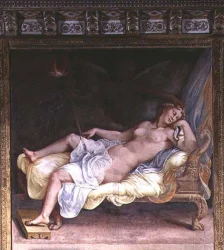
Guinevere
- Early Welsh traditions
- Queen in Geoffrey of Monmouth
- Lancelot and the romance tradition
- From Camelot to the convent
- An enduring, changing queen
Guinevere is the queen at the heart of the Arthurian world: beloved, abducted, accused of betrayal, and bound to the fate of Camelot. She is not a documented historical person with a recoverable life story, but a legendary figure whose character changed as storytellers reshaped Arthur’s court across centuries. In some versions she is the cause of the kingdom’s ruin; in others, a queen caught between political duty and a love that the stories make impossible to ignore.
Early Welsh traditions
Guinevere’s name appears in Welsh tradition as Gwenhwyfar. One of the earliest surviving Welsh narrative references is in *Culhwch and Olwen*, a tale preserved in medieval manuscripts and generally associated with an earlier oral tradition. These early mentions are brief, offering little of the elaborate characterization familiar from later romances.
The oldest stories do not supply a single, consistent account of her family or role. Later writers variously make her the daughter of a king, connect her to Roman or British lineages, or give her several namesakes. This shifting background reflects the growth of Arthurian legend: each writer inherited recognizable characters but could adapt them to a new court, audience, and literary purpose.
Queen in Geoffrey of Monmouth
In the twelfth century, Geoffrey of Monmouth made Guinevere a central figure in his Latin *History of the Kings of Britain*, a work that presented legendary British rulers in the form of national history. Geoffrey’s Guinevere is married to Arthur and left in Britain while the king campaigns abroad. His account says she enters into a relationship with Mordred, Arthur’s nephew, who has seized power in the king’s absence.
Geoffrey’s narrative helped establish the tragic end of Arthur’s reign, though it is not a reliable account of historical events. Its blend of legend, political storytelling, and pseudo-history became influential across Europe. Later authors borrowed its plot while changing the motivations and moral weight of Guinevere’s actions.
Lancelot and the romance tradition
A major transformation came with Chrétien de Troyes’s late twelfth-century poem *The Knight of the Cart*. Chrétien introduced Lancelot as Guinevere’s devoted lover and told of her abduction by Meleagant and Lancelot’s quest to rescue her. The story established one of the most famous love triangles in medieval literature, recasting the queen not only as a political figure but as the beloved at the center of a courtly romance.
Later prose cycles expanded the relationship and its consequences. Guinevere’s love for Lancelot became a source of private anguish and public danger. In many versions, the affair divides the Round Table, gives Arthur’s enemies an opportunity to accuse the queen, and contributes to the collapse of the fellowship. The stories vary over whether Guinevere is condemned, rescued, reconciled with Arthur, or ultimately withdraws from the world.
From Camelot to the convent
In Thomas Malory’s fifteenth-century *Le Morte Darthur*, Guinevere’s relationship with Lancelot becomes inseparable from the fall of Arthur’s kingdom. When their love is exposed, the conflict among the knights leads to civil war. Arthur’s absence gives Mordred the chance to claim the throne, and the battles that follow bring the Round Table era to an end.
Malory’s queen is both vulnerable and formidable. She is capable of tenderness and loyalty, but also of anger and pride. After Arthur’s death, she withdraws to a convent, where she refuses Lancelot when he comes to find her. This ending presents her renunciation as a form of penance and a final attempt to live outside the destructive passions that shaped her life.
An enduring, changing queen
Guinevere has been reimagined in poetry, opera, novels, films, and television, with modern versions often giving her more agency than medieval narratives allowed. Some portray her as a political strategist or a ruler in her own right; others focus on the emotional costs of being placed between Arthur and Lancelot. The old question of whether she is traitor, victim, or lover has no single answer because the legend itself never settled on one.
Her lasting appeal lies in that ambiguity. Guinevere stands at the intersection of love and power, public reputation and private desire. Across the many versions of Camelot, she remains a figure whose choices matter—and whose story changes with every generation that tells it.