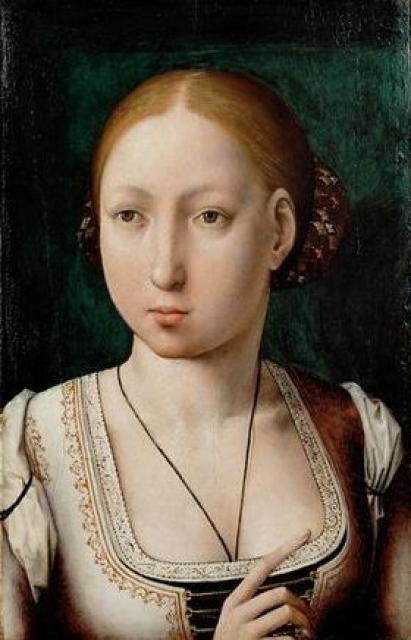
Juana I Bezymnaya
 Spain
SpainJuana I of Castile: Biography
Juana I of Castile, also known as Juana the Mad, was the Queen of Castile from 1504 until her death in 1555. She was the wife of Philip the Handsome, Duke of Burgundy, and after his death, she was believed to have gone mad and was confined to a monastery, with her father and eldest son ruling in her place. Juana was the daughter of the Catholic Monarchs, Ferdinand of Aragon and Isabella of Castile, whose marriage marked the beginning of the unification of Spain. Despite Ferdinand and Isabella having five surviving children, the situation with the inheritance of the unified crowns of Castile and Aragon remained critical. Firstly, only one of their children was a boy - Juan, Prince of Asturias. Among the remaining four infants were Juana and her three sisters. One of them, Catherine of Aragon, was married off to Henry VIII of England for political purposes. The other two, Isabella of Asturias and Maria of Aragon, became the first and second wives of Portuguese King Manuel I, respectively. Juana herself was married to Archduke Philip of Austria, the son of Emperor Maximilian, in 1496. The following year, her brother, Juan Prince of Asturias unexpectedly died, creating a threat to the monarchy's union of Castile and Aragon. The next in line for succession was Juana.
The Reign and Madness
As Juana's marriage began to bear fruit (by 1500, she had already given birth to two children, including a son), it guaranteed a certain stability with regards to the succession to the throne. However, when Juana and her husband arrived in Spain from his Dutch territories in 1502, her mother, Queen Isabella, became convinced that the rumors about her daughter's unstable mental state were true. In 1502, Isabella, the Queen of Castile, Juana's mother, drafted a will appointing her daughter as the sole heiress of Castile. However, she specifically stated that the country would be ruled and governed on behalf of her daughter by her father, Ferdinand II, in case she was deemed unfit to rule. Her son-in-law, Philip of Austria, was not mentioned in Isabella's last will and testament. After Isabella's death in 1505, the Cortes, according to the aforementioned document, recognized Juana as the Queen of Castile. However, her husband Philip declared that he would be the regent of the newly crowned queen, rather than her father, Ferdinand. Thus, Philip became the first King of Castile from the Habsburg dynasty under the name Philip I. But not even a year passed when Philip suddenly fell ill and died in the autumn of 1506. Before his death, he accused his father-in-law of keeping Juana imprisoned and ruling unlawfully in her name. The country stood on the brink of war. (Philip's unexpected death was rumored to be the result of poisoning, with some claiming that Ferdinand had ordered it). After the death of her beloved spouse, the queen fell into a state of madness. She traveled with his body around Castile, refusing to bury him and periodically opening the coffin to gaze upon Philip.
The Life in Confinement
Anarchy reigned in Castile. King Ferdinand was hastily summoned from Aragon to take control of the government. Philip was buried, and Juana was confined in the Castle of Tordesillas in 1509 under strict supervision. She remained there until 1555, the remaining 44 years of her life. Her father died in 1516, after which her son Carlos (Charles V), the future emperor, ruled over Castile (and Aragon as well). Until her death, Juana was considered the rightful queen, and her deposition was never officially declared. However, her name was kept out of the public eye. After decades of poor seclusion, she passed away at the age of 76.
She was buried alongside her husband and parents in the Royal Chapel in Granada. The question of whether Juana truly suffered from madness or if these rumors were related to the efforts of the three men ruling in her name (her husband, father, and son) remains unresolved to this day. The truth is unknown. Written sources provide the following information: Juana had a reserved and melancholic character from an early age, preferring solitude. She was married off at the age of 17. The first reports of her unstable state began to surface after her marriage to Philip the Handsome in 1496. The couple lived in Burgundy, where the court was known for its merriment and courtly behavior. This contrasted with the somber religious life Juana was accustomed to in Spain. It was noted that Juana was madly in love with her husband, but he, after initially showering his young wife with warmth and affection, soon returned to his numerous mistresses. Juana became jealous and felt lonely, as she was isolated from her fellow countrywomen. Courtiers treated her with hostility. Serious outbursts of jealousy and hysterics were observed. In her relationship with her husband, she displayed excessive obsessiveness, while he began to actively avoid her. Nervous attacks occurred frequently, with Juana screaming and pounding on the walls throughout the night.
In 1498, Queen Isabella of Castile sent a special emissary to the Netherlands to investigate the situation, but Juana refused to answer his questions. Upon his return, the envoy reported to Isabella about Juana's melancholy, unhappiness, and lack of influence in politics. Reports of Juana's strange behavior started to reach Spain. In 1501, Juana and her husband were summoned to Spain as Juana became the heir after the death of her brother and sister. In 1502, Queen Isabella of Castile drafted a special will.
Philip, feeling bored with the strict Spanish court, where women were kept hidden, soon returned to his beloved Burgundian court, leaving his pregnant wife behind in Spain. Upon learning of her husband's departure, Juana went into a frenzy and completely lost her mind. She longed to follow her husband, even intending to travel through French territories where a war was raging at the time. The thought that Philip would be surrounded by beautiful mistresses drove her mad. Her condition worsened to the point that her mother had to place her under the guard of the Castle of La Mota, where she finally gave birth to another child - Ferdinand.
Initially, she was not allowed to leave due to her health condition, and then due to disrupted communication caused by the war in France. Finally, her parents asked the princess to stay and learn to rule the kingdom. However, after another scandal where Juana uttered sharp words to her mother, she was allowed to leave.
She returned to the Netherlands in April 1504. Discovering that Philip had indeed taken a mistress, Juana cut off the woman's beautiful hair. Her husband struck her in the face and locked her in a room for several days. Juana went into hysterics and declared a hunger strike. She was left without any courtly women by her side. In 1505, she became the Queen of Castile after her mother's death. According to Ferdinand's orders, the Cortes were read the reports from the Netherlands, which allowed them to show that one of the conditions of Isabella's will was fulfilled - Juana was indeed mentally unstable, and a regent should rule on her behalf. However, Philip had no intention of relinquishing power over the country to his father-in-law. Whoever controlled Juana had to be the regent. Philip died suddenly the following year.
The death of her husband in 1506 deeply affected Juana:
- She did not leave his body.
- She vehemently opposed his burial for a long time.
- Then, she fell into a deep depression, with occasional fits of madness that required constant supervision.
- She was in the final months of pregnancy, which worsened her condition.
- She traveled with the funeral procession throughout the country and several times ordered the coffin to be opened to look at Philip (here, she is diagnosed with necrophilia and necromania).
- Jealous even of his lifeless embalmed body, she prohibited women from approaching the procession.
- She distanced herself from society and often locked herself up (agoraphobia is mentioned here).
A colorful legend states that she ordered the coffin to be opened every night and embraced the embalmed remains of her beloved husband. However, historians claim that she ordered the coffin to be opened for the first time only five weeks after Philip's death to dispel rumors that his body had been stolen. This happened when the coffin was in a temporary tomb in Burgos.
After some time, a plague broke out in Burgos. The queen ordered the procession to move to Torquemada, which was on the way to Granada, where the mausoleum of the monarchs was located, and where she was taking her husband's body. When the preparations for departure were underway, the coffin was opened for the second time (for the same purpose).
The procession moved exclusively at night - "since the poor widow who lost the light of her soul had no reason to appear in the daylight." Juana spent her days in monasteries. She did not stay in women's monasteries, and women were prohibited from approaching the body. Once, the procession accidentally stopped overnight at a women's monastery. They had to leave hastily as soon as the mistake was noticed.
In January 1507, she finally gave birth to a girl named Catherine in the village of Torquemada. The coffin was opened for the third time, and Juana looked at her beloved husband's remains once again.
In Torquemada, Juana lived for several months, without leaving and staying secluded. Upon receiving news that her father had sailed from Naples and was ready to assume power, she ordered the coffin to be opened for the fourth and final time. She never made it to Granada.
Another element of the legend is that Juana traveled with her husband's coffin around the country for several years (up to 3). This is also an exaggeration. The dates and route are fairly well documented. One version suggests that the monks may have implanted the idea in Juana's mind that Philip could be resurrected (there was a prophecy that a prince would do so 14 years after his death). Thus, her desire not to bury him and ensure free access to his remains receives another explanation.
Her father placed her in Tordesillas. After her father's death in 1516, her son Charles, the future emperor, came to visit his mother with his sister Eleanor. He was shocked not only by how much she neglected hygiene and comfort for herself and her daughter but also by the lifestyle Juana led. Her usual diet consisted of bread and cheese. They were left at her door, and she did not allow anyone to see her eat. Charles told the guards, "It seems to me that the most necessary and essential thing would be for no one to see Her Majesty. Because nothing good can come of it." Besides necrophilia, which is quite debatable, her diagnosis includes "typical schizophrenia," and "hereditary illness" (referring to her grandmother, Queen Isabella of Portugal, the wife of King Juan II of Castile, whose schizophrenia has been confirmed by scientists today). The trait would be encountered quite often among her Habsburg descendants. Juana gave birth to six children:
- Eleanor of Austria (1498–1558)
- Carlos (Charles V) (1500–1558)
- Isabella of Austria (1501–1526)
- Mary of Hungary (1501–1558)
- Ferdinand (Ferdinand I) (1503–1564)
- Catherine of Austria (1507–1564)