
Gulielmo Markoni
 Italy
Italy- Early Years and Education
- Fascination with Physics and Wireless Telegraphy
- Initial Successes and Government Disinterest
- Breakthroughs in England
- Technological Innovations and the Nobel Prize
- Military Service and Later Career
- Personal Life and Legacy
Early Years and Education
Guglielmo Marco Marconi, an Italian electrical engineer and inventor, was born in Bologna, Italy. He was the second son of Giuseppe Marconi, a landowner, from his second marriage to Annie Jameson, an Irish woman. Before attending the technical institute in Livorno, Marconi studied with tutors in Bologna and Florence.

Fascination with Physics and Wireless Telegraphy
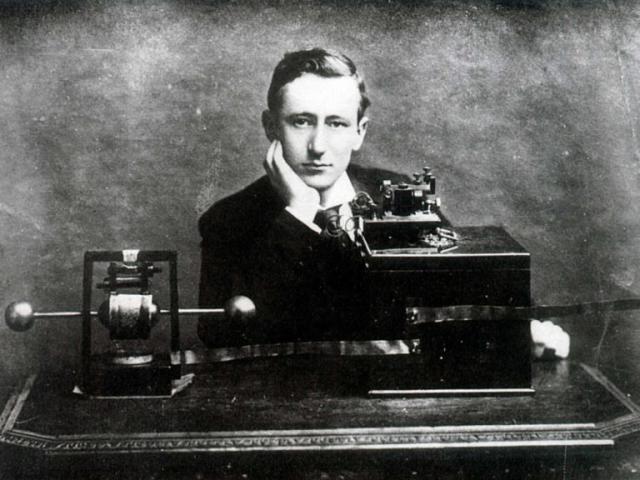
At the age of 20, Marconi became fascinated with physics, particularly the electrical theory research of James Clerk Maxwell, Heinrich Hertz, Édouard Branly, Oliver Lodge, and Augusto Righi. In 1894, he learned about an experiment conducted in 1888: an electrical spark across a gap between two metal balls produced periodic vibrations or impulses (Hertzian waves). Marconi envisioned using these waves to transmit signals through the air without wires. He dedicated the next four decades of his life to wireless telegraphy, constantly improving its efficiency and range.
Initial Successes and Government Disinterest
With guidance from Righi, Marconi used Hertz's vibrator and Branly's coherer (a detector of Hertzian waves that converted oscillations into electric current) to transmit a signal that rang an electric bell across the lawn of his father's estate. By mid-1895, Marconi created a more sensitive and reliable coherer, incorporated a telegraph key into the transmitter circuit, grounded the vibrator, and connected one end to a metal plate suspended high above the ground. These improvements enabled him to transmit a signal over 1.5 miles.
Disinterested in his invention, the Italian government prompted Marconi to travel to England in search of funding and commercial support. In 1896, his cousin Henry James Davis helped him file his first patent for a radiotelegraphic system.
Breakthroughs in England
Despite a setback when suspicious customs officers broke his wireless apparatus, Marconi successfully demonstrated it to British entrepreneurs and government officials. By September 1896, he had improved his system to transmit signals almost two miles. When the Italian government demanded three years of military service, Marconi arranged to serve in absentia as a cadet at the Naval College attached to the Italian embassy in London.
In May 1897, he transmitted signals across the Bristol Channel, a distance of nine miles. That July, Marconi and a small group of investors formed the Wireless Telegraph and Signal Company to install apparatus on lighthouses and coastal stations in England. In the process, Marconi discovered that the transmission range increased with the number and length of antennae used. To transmit a signal 28 miles across the English Channel, he used an array of antennae, each 150 feet tall.
Technological Innovations and the Nobel Prize
In 1900, based on the discovery of Ferdinand Braun, Marconi incorporated a capacitor and a tuning coil into his transmitter, increasing the energy of the signal. The capacitor amplified the oscillations created by the spark gap, and coils tuned the period of oscillations in the antenna to match the amplified oscillations. These two circuits could now be tuned to resonate, reducing signal loss due to interference. Marconi also enhanced reception by incorporating a tuning coil into the receiver, ensuring that only oscillations tuned to the transmitter's frequency were received by the coherer, excluding signals from other antennae. Patent No. 7777, granted in April 1900, essentially gave Marconi a monopoly on the use of tuned transmitting and receiving circuits. His company was renamed the Marconi Wireless Telegraph Company Limited. By the end of 1900, Marconi had extended the transmission range to 150 miles.
In January 1901, he established wireless contact between points on the English coast separated by 186 miles. Later that year, while in St. John's, Newfoundland, Marconi received a signal transmitted across the Atlantic Ocean from Cornwall, England, a distance of 2,100 miles. In 1902, Marconi sent the first west-to-east wireless signal across the Atlantic. He patented directional signal transmission in 1905.
In 1907, Marconi opened the first transatlantic wireless telegraph service. In 1912, he received a patent for an improved timed-spark system for generating transmission waves. Marconi and Braun were jointly awarded the 1909 Nobel Prize in Physics "in recognition of their contributions to the development of wireless telegraphy."
Military Service and Later Career
During World War I, Marconi undertook military missions and eventually became commander of the Italian navy. He also oversaw the Italian armed forces' telegraphy program. In 1919, he was appointed Italian plenipotentiary to the Paris Peace Conference and signed treaties with Austria and Bulgaria on behalf of Italy.
Converting his steam yacht "Elettra" into a home, laboratory, and office, Marconi embarked on intensive research into shortwave telegraphy in 1921. By 1927, Marconi's company had established a global network of commercial shortwave telegraph links. In 1931, Marconi began investigating microwave transmission and established the first microwave radiotelephone link the following year. In 1934, he demonstrated the use of microwave telegraphy for open-sea navigation.
Personal Life and Legacy
Marconi married Beatrice O'Brien, an Irish woman, in 1905. They had three children. After divorcing in 1924, Marconi remarried Countess Bezzi-Scali, with whom he had a daughter. Marconi died on July 20, 1937, in Rome. Among his many honors, he received the Franklin Medal from the Franklin Institute and the Albert Medal from the Royal Society of Arts in London. In Italy, he was granted the hereditary title of Marchese, became a senator, and was awarded the Grand Cross of the Order of the Crown of Italy.


