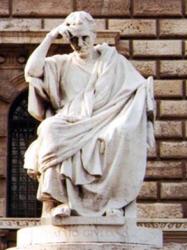
Hadrianus
 Italy
Italy- Early Life and Rise to Power
- Reign as Emperor (117-138 CE)
- A Patron of the Arts and Architecture
- Domestic and Military Reforms
- Suppression of Jewish Revolt and Construction of Hadrian's Wall
- The Tragedy of Antinous
- Later Years and Legacy
Early Life and Rise to Power
Hadrian, the Roman Emperor known for his military prowess and architectural legacy, was born into a senatorial family in Italy. Upon losing his father at the tender age of ten, he was raised under the watchful eye of his cousin, Emperor Trajan. Through Trajan's patronage, Hadrian swiftly ascended the ranks of government, culminating in his marriage to Trajan's granddaughter in 100 CE.

Reign as Emperor (117-138 CE)
Following Trajan's death in 117 CE, Hadrian was proclaimed Emperor in Syria. His reign marked a shift from his predecessor's aggressive expansionist policies. Recognizing the limits of the empire's resources, Hadrian withdrew from certain conquered territories and focused on consolidating and strengthening Roman borders.
A Patron of the Arts and Architecture
Adrian was a renowned patron of the arts. He adorned his favorite city, Athens, with magnificent structures such as the Temple of Olympian Zeus. His appreciation for Greek literature and culture extended to Egypt, where he supported the worship of Egyptian gods.
Domestic and Military Reforms
To ensure the stability of the empire, Hadrian implemented several domestic reforms. He reorganized Italy into four administrative districts and reserved high government positions exclusively for Roman citizens. His military reforms and the construction of fortifications along the frontiers maintained peace within the empire.
Suppression of Jewish Revolt and Construction of Hadrian's Wall
In 132-135 CE, Hadrian faced an uprising in Judea led by Bar Kokhba. After a bloody conflict, the Jewish forces were defeated, Jerusalem was destroyed, and the region was transformed into a Roman colony. During his reign, Hadrian also commissioned the construction of Hadrian's Wall in Britain to defend against northern tribes.
The Tragedy of Antinous
One of the defining moments of Hadrian's reign was the tragic death of his beloved favorite, Antinous. In 130 CE, while traveling in Egypt, Antinous drowned in the Nile. Hadrian's grief knew no bounds, and he ordered priests to deify Antinous, establishing a cult that spread throughout the empire.
Later Years and Legacy
In his later years, Hadrian suffered from health problems. He entrusted his rule to his adopted son, Antoninus Pius, before passing away in 138 CE. Before his death, he composed an eloquent epitaph that reflected on the transience of life. Hadrian's legacy extends beyond his reign to the present day, remembered for his contributions to architecture, art, and military strategy.