Hafez
- Childhood and Background
- A Poet in a Changing Shiraz
- The Divan and the Ghazal
- Private Life and Legends
- Legacy
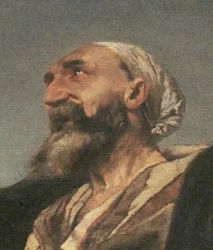
Hafez became one of the most beloved voices in Persian literature with poems that can sound like love songs, mystical visions, political commentary, and sharp attacks on hypocrisy all at once. He spent nearly his entire life in Shiraz, where rival rulers came and went, and his lyric poems outlived them all. The details of his private life remain uncertain, but his collected work has become so familiar that many readers know lines by heart and turn to the book for guidance.
Childhood and Background
Hafez’s name was Shams al-Din Muhammad Shirazi. He was born in Shiraz around 1315 or 1317, although both his birth and death dates are debated. Most modern scholars place his death around 1390. Even the basic story of his family is unclear: later accounts offer conflicting names and origins for his father, and many anecdotes attached to the poet cannot be verified.
The name “Hafez” is generally understood to refer to someone who had memorized the Qur’an. His poems are filled with echoes of scripture, and the earliest biographical tradition says he studied Qur’anic sciences and Arabic. Beyond that, the record is thin. Hafez’s poetry hints at personal grief and family experience, but it is risky to treat every lyric as autobiography: the speaker in a poem is not automatically the historical poet.
A Poet in a Changing Shiraz
Hafez lived through the rise and fall of local dynasties in fourteenth-century Persia. Shiraz was a center of scholarship and poetry, but it was also shaped by court rivalries, military campaigns, and sudden changes in power. The poet addressed rulers and officials in his verses, sometimes praising patrons and sometimes reflecting on the losses that followed their defeat.
His work was associated with several leaders, including Abu Ishaq Inju and the Muzaffarid ruler Shah Shuja. Hafez’s relationship with court patronage was not simply ceremonial: his poetry could praise a ruler while hinting at the fragility of power, or use the language of wine and celebration to contrast one reign with another. He lived to see Timur’s expansion into the region, but stories about a personal encounter between the conqueror and Hafez belong to later legend rather than securely documented biography.
The Divan and the Ghazal
Hafez is known above all for the ghazal, a lyric form built from linked couplets, formal rhyme, and often a repeated refrain. His surviving Divan contains fewer than five hundred poems generally accepted as authentic, though manuscripts differ in which poems and lines they include. A definitive original text has never been established, and editors must weigh competing versions.
His ghazals return to love, longing, separation, beauty, wine, and the beloved. They also ridicule the self-important preacher, judge, or moral guardian who publicly condemns pleasure while privately acting against the standards he preaches. That blend of sensuality, wit, spiritual language, and social criticism gives the poems their distinctive tension. Hafez’s images rarely settle into just one meaning: wine may evoke celebration, transgression, or mystical freedom, and readers have long disagreed over how literally to understand it.
Private Life and Legends
There is no dependable record of Hafez’s romantic relationships, daily habits, or household. Later writers turned him into an inspired sage, sometimes attributing miraculous predictions to him. His reputation as the “Tongue of the Unseen” grew after his death and became closely associated with the Divan itself. These stories show how readers received his work, but they are not reliable evidence about his personal life.
Legacy
Hafez died in Shiraz around 1390 and was buried there. His poems were gathered into a collection after his death, and the Divan became a fixture of Persian literary and cultural life. Readers still open it at random for fal-e Hafez, a form of bibliomancy in which a poem is treated as a response to a question or a glimpse of what lies ahead.
His influence reaches far beyond the court culture in which he wrote. Generations of poets and readers have found in his work a voice that can be tender, skeptical, playful, and unsettling within a few lines. The enduring mystery is part of the appeal: little is certain about Hafez’s private story, while the poems continue to feel startlingly alive.