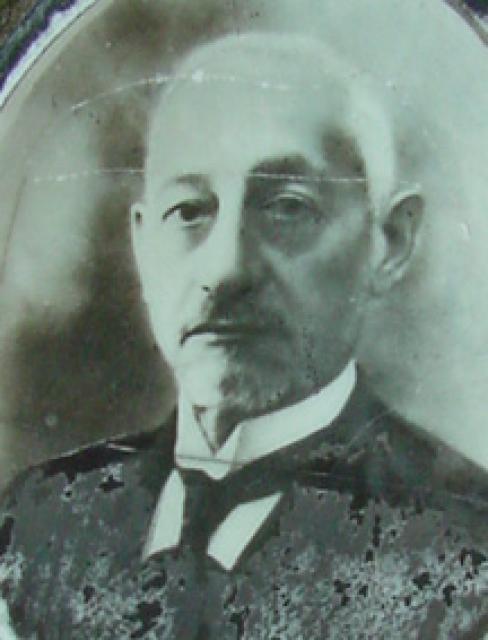
Haim Vital
 Israel
- Biography of Chaim Vital
- Entering the World of Kabbalah
- Becoming a Disciple of Rabbi Isaac Luria
- Escape to Damascus and Later Life
- Chaim Vital's name is commemorated by a street in Jerusalem.
Biography of Chaim Vital
Early Life and EducationChaim ben Yosef Vital, also known as Rabbi Chaim Vital Calabrese, was born in 1543 in Safed, Israel. His family hailed from Calabria, Italy. According to the Jewish calendar, he was born on the 1st day of the month of Cheshvan in the year 5303 and passed away on the 30th day of the month of Nissan in the year 5380. Chaim Vital studied under the tutelage of Talmudic scholar and Kabbalist Rabbi Moshe Alsheich during his youth. Legends surround Chaim Vital's early years, including a palm reader predicting that he would face a critical decision when he reached the age of twenty-four.
Entering the World of Kabbalah
It is said that Rabbi Yosef Karo, author of the Shulchan Aruch, took notice of Chaim Vital's abilities and in 1557, asked Rabbi Alsheich to take special care of him, believing in Chaim Vital's destiny to follow in his teacher's footsteps in the world of study. It was during this time that Chaim Vital first encountered Kabbalist Rabbi Lapidot Ashkenazi, who would have a significant influence on his life. Chaim Vital married at a young age, but the marriage was unhappy. In a dream, the prophet Elijah led him to a beautiful garden, where he saw righteous individuals of all ages in the form of birds flying through the garden and studying the Mishnah. In the center of the garden was God, seated on a throne surrounded by devout followers and intricately woven tapestries. Convinced by this vision that he was destined to become a Kabbalist, Chaim Vital dedicated the next two and a half years to studying alchemy and magic. After completing his studies, Elijah appeared to him again in a vision and told him that he would succeed in his endeavors and even write a commentary on the Zohar.
Becoming a Disciple of Rabbi Isaac Luria
In 1570, Chaim Vital became a disciple of Rabbi Isaac Luria, also known as the Ari, the leading Kabbalist of his generation. Within a year, Chaim Vital distinguished himself as the Ari's top student, and when the Ari passed away in 1572 at the age of thirty-eight, Chaim Vital became his successor. As the Ari left behind very little of his teachings in written form, Chaim Vital began recording everything he had learned from his mentor, word for word.
Escape to Damascus and Later Life
Refusing to fulfill a request from the Ottoman governor, Chaim Vital fled to Damascus using the power of Practical Kabbalah. There, his mentor appeared to him and told him that he had a chance to bring about the final redemption by releasing the waters of Gihon, and now that chance had passed. This greatly saddened Chaim Vital. In Damascus, he began writing his first work, "On Abraham." The majority of the book consists of explanations of cloud magic and discussions on the seven fixed stars (planets) and the corresponding metals. After completing the book, Chaim Vital returned to Jerusalem, where his former teacher, Rabbi Moshe Alsheich, appointed him as a Rabbi in 1584. However, after some time, Chaim Vital left Jerusalem for Safed, where he fell ill and was bedridden for a year.
During this illness, his closest disciple, Yehoshua, who accompanied Chaim Vital on almost every journey, managed to bribe Chaim Vital's younger brother, Moshe, with 500 gold coins to provide him with copies of the teachings of the Ari that were locked away in a box. Moshe complied, and 100 scribes were immediately employed to reproduce the manuscripts. Within three days, they were able to reproduce over 600 pages. In 1594, Chaim Vital settled permanently in Damascus, where he lectured on Kabbalah every evening. He passed away in 1620, while preparing to return to Safed.


