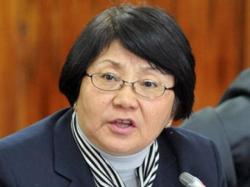
Hanna Karhinen
 Finland
- Early Life and Education
- Political Activism
- Finnish Civil War
- In Sweden and the United States
- In the USSR
- Legacy
- Personal Life
Early Life and Education
Hanna Karhinen was born on June 16, 1878, in Viipuri (modern-day Russia) to Johan Fredrik Andelin and Johanna Natalia Malmström. Her father passed away just a week before her birth, leaving little known about her early life. However, it is known that she attended primary and church school in St. Petersburg, where she studied the Russian language.
Political Activism
In 1902, Karhinen joined the Social Democratic Party of Finland and soon rose to prominence. She became the chairperson of the women's section of the Terijoki Workers' Union and served on the Federal Council of the Social Democratic Women's Union. Karhinen played an active role in the publication of "Women Workers" and authored educational pamphlets for women. Her writings promoted modern child-rearing practices and encouraged working women to participate in municipal politics.
In 1913, Karhinen was elected to the Finnish Parliament. She served two terms but lost her seat in the 1917 elections.
Finnish Civil War
During the Finnish Civil War of 1918, Karhinen served as a secretary and translator in the Department of Internal Affairs of the People's Executive Committee of Finland. She was also elected to the Workers' Supreme Council and became the chairperson of the Committee on General Affairs of the People's Executive Committee. In March, Karhinen joined the Council as the second Commissioner of Internal Affairs alongside Matti Airola.
In April, Karhinen traveled to Soviet Russia with a delegation, reportedly to transport funds from the Bank of Finland. After her return, she resigned from the Council due to her opposition to the conscription of soldiers.
In Sweden and the United States
Following the Battle of Viipuri, Karhinen fled to Russia again. She joined the Communist Party of Finland in Moscow in the autumn of 1918. From 1918 to 1920, she lived in Sweden as a political refugee.
In 1920, Karhinen was sent to the United States as an agent of the Comintern. She used the pseudonym "Anna Leppänen" and worked with various socialist organizations. Karhinen resided in the United States until 1926.
In the USSR
In 1926, Karhinen settled in the USSR, working in various roles in the Karelian ASSR. She eventually became a translator for the People's Commissariat of Education in 1927.
In 1936, Karhinen was expelled from the party for alleged connections with enemies. She was arrested in June 1938 during the Great Terror and accused of counter-revolutionary activities. Karhinen was executed on September 27, 1938, near Olonets.
Legacy
In 1989, Karhinen was rehabilitated by the Supreme Soviet of the USSR.
Personal Life
In 1899, Karhinen married Tuomas Tuomaanpoika Karhinen, a railway police officer. They had one daughter, Viira Muberg. The couple divorced in 1913.