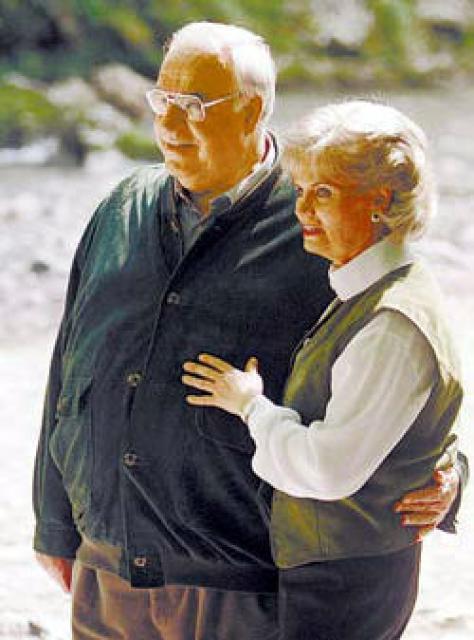
Hannelore Kohl
 Germany
Biography of Hannelore Kohl
Hannelore Kohl, the wife of the Chancellor of the Federal Republic of Germany, shocked the country with her suicide at the age of 68. It was not a spontaneous decision, as the former First Lady carefully planned every detail. According to an official statement from Helmut Kohl's office, "Hannelore Kohl voluntarily left this life, unable to bear the suffering caused by a debilitating allergy to light."
Speculations about the reasons behind her suicide emerged in the world's major newspapers. Some blamed Kohl himself, accusing him of neglecting his wife, while others criticized the doctors for not adequately addressing her depression. "Rest in peace" echoed a week ago, but the final act of this tragedy is not yet complete, as many details are yet to be revealed. It is now clear that very little was known about Hannelore Kohl.
Hannelore left eight farewell letters - one to her husband, each of her sons (marked "Open immediately"), and close friends. She also left another letter, without an envelope, prominently displayed for the first person to enter the room, in order to soften the shock and clarify the situation. She then mixed sleeping pills with morphine and drank the deadly cocktail through a straw. A note attached to the bedroom door read, "I went to bed late yesterday. Please do not disturb, I want to rest."
At 11:15 am, the housekeeper discovered the lifeless body. Helmut Kohl was in Berlin, attending a plenum in the Reichstag when he was informed that his wife had been found dead in their home in Ludwigshafen. He turned pale, stumbled, and leaned against the wall for a few moments. An hour and a half later, Kohl, accompanied by a police escort, arrived at his villa from the airport. Hannelore had written to him, "I have always loved you very much. And I thank you for everything you have done for me." They had met at a dance in 1949 when she was 15 years old, wearing a dress made from two flags with a carefully cut-out swastika.
For 16 years, Hannelore Kohl was the First Lady of Germany. She maintained exceptional discipline, never complained, always smiled according to protocol, and maintained an impeccable appearance. Her role was to stay in the shadow of her influential husband, creating a solid support system and protecting the family's private life from intrusion by the press. She especially guarded her sons Walter and Peter, who, after receiving higher education in the United States, became businessmen without ever being involved in scandal or gossip.
Helmut Kohl, who once wrote her over 2,000 love letters, would only be at home in Ludwigshafen on weekends, spending the rest of his time in their Berlin apartment. From the few interviews with the Chancellor's wife, it can be concluded that the words "wait," "endure," and "adapt" were central to her life. The jokes about Helmut and his Hannelore were as numerous as those about fictional characters Petka and Vasily Ivanovich. In one talk show, she admitted to being aware of the nicknames she was given: "provincial cow" and "dumb blonde," whose main purpose was to prepare the Chancellor's favorite dish, stuffed pig stomach. Despite being a trained translator, she devoted her entire life to her family. She had to "share" her husband with the entire nation. "Complete loneliness at home, when dinner is ready and he doesn't come and only calls again and again to say he's delayed... After 4-5 hours of waiting like that, you can only demand that a dog still be happy when its owner arrives," Hannelore once said. "And that's what I learned from our dog." For a year and a half, the blinds in the Kohl family's house remained closed to prevent any ray of light from entering. In recent times, even warmth in the room would worsen her condition, so the villa was kept at a minimum temperature. Hannelore could only go outside closer to nightfall. German media collected bits and pieces of information about Mrs. Kohl's health: an intolerance to daylight, unbearable pain, strong medication (morphine), doctors' helplessness in Germany and abroad, and the fatal consequences of taking three penicillin tablets. These aspects are contradictory and do not fit solely into the clinical picture of an allergic condition. They more likely reflect the cry of a suffering soul: "I need help, support, do not leave me alone!" The tragedy of Hannelore Kohl is that she had to play the role of a strong woman throughout her entire life. "I am burning from within," she once confessed to a friend.
Interestingly, her health deteriorated at the moment when a scandal erupted involving the "black fund" of her husband's party after his departure from office. Her own initiative, the Foundation for the Assistance of Central Nervous System Disorders, for which she raised over 30 million German marks in donations, was accused in the press of money laundering. Helmut Kohl wrote in his recently published "Diary," "I was afraid that my wife couldn't bear this." Yet, she continued to smile for the cameras. Deep down, she remained a little girl, who had experienced the fear of war, hunger, homelessness, and violence, and who desperately needed protection. "I was so happy to meet a man as strong as a mountain, someone I could lean on," she would later say about the young Helmut Kohl. Could he protect her while also falling from the pedestal of one of the most powerful people in the world?
Ultimately, no one will ever know which factor - the illness itself, loneliness, or the specific challenges and uncertainties of being the wife of a political leader - weighed more heavily in her decision to end it all. As Hannelore dissolved one sleeping pill after another, Helmut Kohl celebrated his victory with his lawyers at a Berlin restaurant: a court decision not to disclose the files collected on the Chancellor by the East German secret service, the "Stasi." Hannelore waited for the verdict of the judges. Now she could finally rest in peace.
During her funeral, Verdi's "Requiem" resounded, and tears streamed down Helmut Kohl's face. Fate had struck him once again, forcefully...


