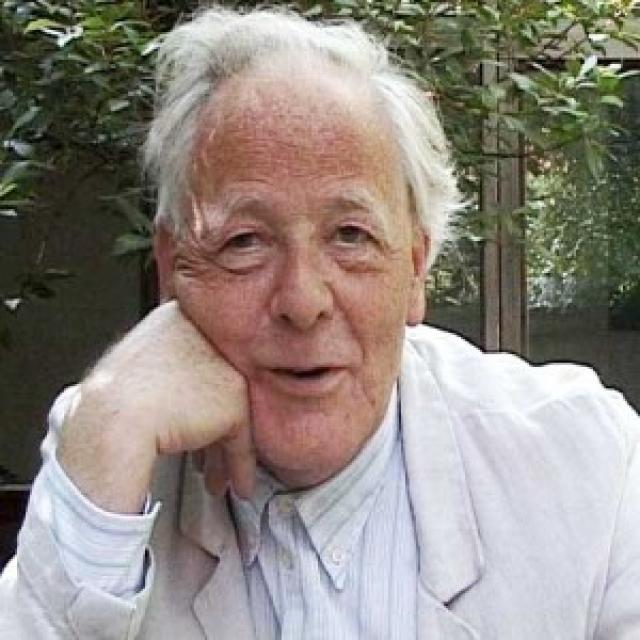
Hans-Jurgen Syberberg
 Germany
Biography of Hans-Jürgen Syberberg
German film director, screenwriter, and producer, Hans-Jürgen Syberberg was born on December 8, 1935, in Nossendorf, Pomerania, in a noble family. He lived in the village until 1947, then moved to Rostock. At a young age, thanks to Benno Besson, he received permission from Bertolt Brecht to visit the Berliner Ensemble, where he made his first films on 8mm, documenting rehearsals of "Puntila," "Mother," and "Faust" in 1952-1953.
In 1953, Syberberg moved to West Germany. From 1956 to 1962, he studied philology and art history at the University of Munich, defending his dissertation on the absurd in the works of Friedrich Dürrenmatt. From 1963 to 1966, he worked as a freelance employee for Bavarian Television, capturing portraits of Fritz Kortner, Romy Schneider, as well as the eccentric impoverished Bavarian aristocratic Poche family and the Bavarian "porn king" Alois Brummer.
Early Films and German Trilogy
In the late 1960s and early 1970s, Syberberg made his first feature films, "The Scarab - How Much Land Does a Man Need?" (1968) and "San Domingo" (1970). The former was based on a story by Leo Tolstoy and presented a surrealist film with shocking scenes of violence. "San Domingo," inspired by Heinrich von Kleist's novella, took place in a setting of drug addicts, rockers, and revolutionary-minded students.
Syberberg gained widespread recognition with his "German Trilogy," which consisted of baroque-theatrical films reminiscent of Wagner and, at the same time, Brechtian in their explicitness of techniques and direct address to the audience. The trilogy included "Ludwig: Requiem for a Virgin King" (1972, about King Ludwig II of Bavaria), "Karl May" (1974, about Hitler's favorite writer and author of adventure novels about American Indians), and the seven-hour epic "Hitler: A Film from Germany" (1978, released in the US as "Our Hitler" by Francis Ford Coppola).
In 1981, he continued the series with a free adaptation of Wagner's opera "Parsifal."
Later Life and Controversy
Syberberg currently lives in his ancestral estate in Nossendorf, which he acquired in 2002 and restored despite local opposition. His innovative and consistently radical cinematic approach, which unfolds and simultaneously exposes the central myths and mythologized figures of German history from the 19th to the 20th century, attracted the attention of philosophers, cultural researchers, historians, and film theorists beyond Germany, such as Susan Sontag, Gilles Deleuze, Philippe Lacoue-Labarthe, and Serge Daney. However, his work was received with caution and even hostility by German film critics, leading to Syberberg's estrangement from the film industry and a decline in his creative activity.
In May-June 2003, the Centre Pompidou in Paris presented an extensive exhibition and retrospective of his films. Syberberg also appeared in documentaries such as "This Film" (1981, directed by Werner Biedermann, featuring Alexander Kluge and others), "Night of the Filmmakers" (1995, directed by Edgar Reitz, along with Leni Riefenstahl, Volker Schlöndorff, Werner Herzog, Wim Wenders, and Peter Lilienthal), and "Easter" (2004, directed by David Bereson and Daniel Ross, featuring Philippe Lacoue-Labarthe, Jean-Luc Nancy, and Bernd Stiegler, about Martin Heidegger).