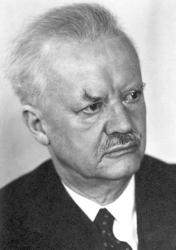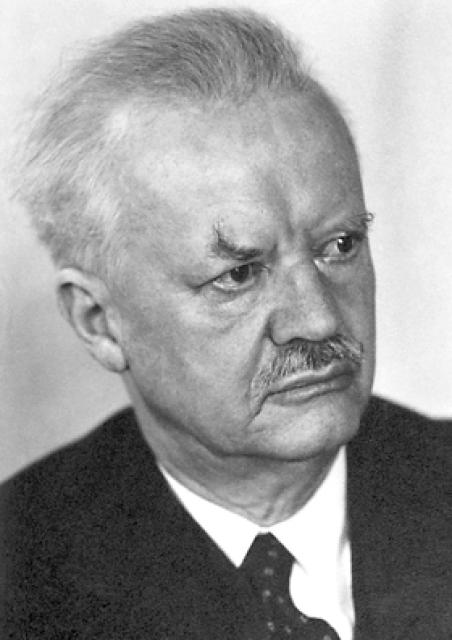
Hans Spemann
 Germany
- Early Life and Education
- Pivotal Research on Embryology
- Discovery of Organizational Centers
- Contributions to Biology
- Personal Life and Legacy
Early Life and Education
Hans Spemann was born in Stuttgart, Germany on June 27, 1869, to Johann Wilhelm Spemann, a publisher, and Lisinka Spemann (née Hofmann). Growing up, Hans displayed a keen interest in literature. Nevertheless, he chose to pursue a career in medicine. In 1891, he enrolled at the University of Heidelberg, initially intending to become a physician.
Pivotal Research on Embryology
During his studies, Spemann became captivated by embryology. In 1893, he transferred to the University of Würzburg and began working on his doctoral dissertation under the guidance of Theodore Boveri. Spemann's research focused on the embryonic development of the lens in the eye of the newt. Inspired by studies conducted by his colleague Gustav Wolff, he investigated the mechanisms underlying lens formation and regeneration.
Discovery of Organizational Centers
Spemann's groundbreaking experiments led him to the discovery of organizational centers in the embryo. These areas, when transplanted to different locations, exerted inductive effects on surrounding tissues, dictating the pattern of organogenesis. This discovery revolutionized embryology and earned Spemann the Nobel Prize in Physiology or Medicine in 1935 for his "discovery of the organizer effects in embryonic development."
Contributions to Biology
Beyond his Nobel-winning work, Spemann made significant contributions to the field of developmental biology. His meticulous experimental techniques and incisive questions laid the foundation for subsequent research on embryonic development. In 1936, he published his seminal book "Embryonic Development and Induction," which became a classic text in the field.
Personal Life and Legacy
In 1895, Spemann married Clara Binder, and they had two children together. He cherished discussions about art, literature, and philosophy, believing that an analytical mind should be complemented by artistic sensibilities to fully comprehend the intricacies of living organisms. Spemann passed away on September 12, 1941, leaving behind a legacy that continues to inspire researchers in the field of embryology.