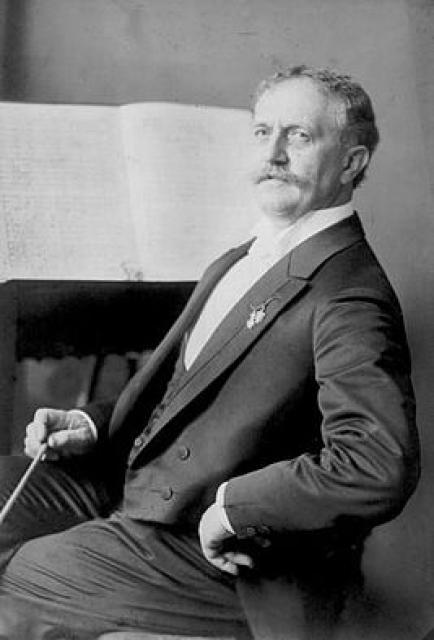
Hans Winderstein
 Germany
- Franz Wüllner: A Pioneer of German Music
- Orchestral Leadership
- Leipzig Years and Orchestral Success
- American Tour
- Compositions
Franz Wüllner: A Pioneer of German Music
Early Life and Musical EducationFranz Wüllner, a German conductor, was born in Münster in 1832. In 1877, he enrolled in the Leipzig Conservatory, where he studied violin under Henry Schradieck. Concurrently, he received guidance in theory from E. F. Richter and Wilhelm Rust, while also playing in the Gewandhaus Orchestra.
Orchestral Leadership
From 1880 to 1884, Wüllner became the concertmaster of Baron Pavel von Derwiz's private orchestra in Nice. Subsequently, he assumed the role of conductor at the Winterthur Conservatory and led the city's orchestra.
In 1887, he took on conducting positions in Nuremberg and Furste. A significant milestone in his career came in 1893 when he became the founding conductor of the Kaim Orchestra in Munich (now the Munich Philharmonic).
Leipzig Years and Orchestral Success
Wüllner returned to Leipzig in the mid-1890s and established the Winderstein Orchestra. This ensemble achieved notable successes under his direction, performing throughout Leipzig and Halle. Notably, they championed the works of contemporary composers, including Gustav Mahler's Sixth Symphony.
American Tour
In 1901, the Winderstein Orchestra embarked on an extensive tour of the United States. The program featured renowned soloists such as Josef Slivinski (violin) and Josef Hofmann (piano).
Compositions
Beyond his conducting prowess, Wüllner composed several concert pieces for orchestra, violin, and piano. His legacy as a musical pioneer continues to inspire generations of musicians.