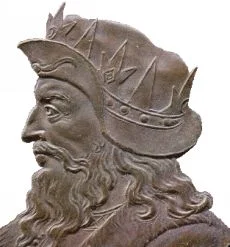
Harthacanute
Harthacnut ruled England for only two years, but his short reign marked a turning point between the Danish dynasty of Cnut and the restoration of the old English royal line. The son of Cnut and Emma of Normandy, he inherited the Danish throne while still a young man and initially struggled to secure his claim in England from abroad. When he finally crossed the North Sea, his half-brother Harold Harefoot had died, leaving Harthacnut able to take the English crown. His sudden death in 1042 ended the Danish succession in England and cleared the way for his half-brother Edward the Confessor.
Heir to Cnut’s kingdoms
Harthacnut, also known as Hardacnut or Hardicanute, was born around 1018. He was the son of Cnut, king of England and Denmark, and Emma of Normandy, who had earlier been the queen of Æthelred II of England. Through his parents, Harthacnut belonged to two powerful dynastic traditions, and his father intended him to succeed to the kingdoms he had assembled.
When Cnut died in 1035, Harthacnut was in Denmark, where he faced political and military pressures. In England, his mother Emma and her supporters advanced his claim, while many magnates north of the Thames supported Harold Harefoot, Cnut’s son by Ælfgifu of Northampton. Harold was first accepted as regent and then recognized as king. Harthacnut’s inability to return quickly weakened his position. By 1037, Harold held the English throne and Emma had been driven into exile in Flanders.
King of Denmark and England
Harthacnut became king of Denmark in 1035, but he did not secure England until Harold’s death in 1040. He had been preparing to cross the sea, and English nobles invited him to take the crown. He arrived with a fleet and succeeded without a major battle. His rule restored the connection between England and Denmark under one monarch, though the union lasted only for the remainder of his life.
The king’s government relied on a heavy tax to support the fleet and royal administration. The Anglo-Saxon Chronicle remembered the levy as severe, and resentment grew when Harthacnut’s officials collected it. In 1041, after two tax collectors were killed in Worcester, the king ordered a punitive campaign against the city and its surrounding region. This response contributed to his reputation for harshness. The Chronicle, written from an English perspective, judged him severely, describing him as a ruler who did nothing worthy of a king; the brief reign and the burden of taxation shaped that hostile legacy.
Harthacnut also addressed the unsettled question of succession. He invited his half-brother Edward, son of Æthelred II and Emma, to return from exile. Edward came to England in 1041 and was recognized as Harthacnut’s intended successor, helping to secure a transition between rival branches of the royal family.
Sudden death and succession
On 8 June 1042, Harthacnut collapsed and died while attending a wedding feast, according to the English chronicle tradition. He was about twenty-four years old. He left no children, and with his death the Danish line established by Cnut ended in England. Edward succeeded him and was later remembered as Edward the Confessor.
Harthacnut’s reign has often been reduced to its taxation and abrupt ending, but it also reflected the difficulty of holding together a northern European empire after Cnut’s death. His claim depended on distance, alliances, and timing; by the time he reached England, another claimant had already taken power. His two years as king brought the competing claims to a close, even as his early death opened a new chapter in English royal history.