Chlodio
- A Frankish leader in Roman Gaul
- Campaigns around Cambrai
- The Merovingian connection
- A fragmentary legacy
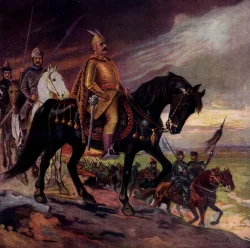
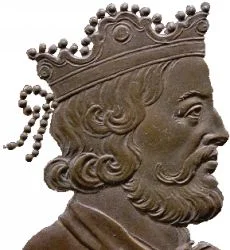
Chlodio was a Frankish king of the fifth century whose campaigns helped extend Frankish control into Roman Gaul. He is known through a handful of references rather than a continuous biography, but those notices place him near Cambrai and the Somme at a time when Roman authority in the West was weakening. Later writers also connected him to the origins of the Merovingian dynasty, though the exact family relationship remains uncertain.
A Frankish leader in Roman Gaul
Chlodio, also spelled Chlogio or Cloio, was a ruler among the Salian Franks, a people whose settlements lay along the lower Rhine and in northern Gaul. The year of his birth and the details of his early life are unknown. His name appears in a poem by the fifth-century Gallo-Roman writer Sidonius Apollinaris and in a later history by Gregory of Tours.
The Roman Empire still claimed authority over much of Gaul during Chlodio’s lifetime, but its ability to defend distant provinces was increasingly strained. Frankish leaders used this weakening frontier to extend their power south and west. Their movements formed part of a larger transformation in which Roman provincial structures gradually gave way to new kingdoms.
Campaigns around Cambrai
Gregory of Tours reports that Chlodio led the Franks across the Roman frontier and captured Cambrai, then pushed south as far as the Somme. The passage is one of the main sources for his career. Sidonius also refers to a Frankish leader named Cloio, describing a clash with Roman forces in the region of Artois. These accounts suggest that Chlodio’s expansion met resistance from the Roman commander Aetius, though the sequence and precise dates are difficult to establish.
The territorial gains associated with Chlodio gave the Franks a foothold in northern Gaul. They helped pave the way for later Frankish expansion under rulers such as Childeric and Clovis. The boundaries of Chlodio’s domain are not known with precision, and the evidence does not provide a detailed picture of his administration or court.
The Merovingian connection
Gregory of Tours records that people in his own time believed the Merovingian dynasty descended from Chlodio. The later Chronicle of Fredegar presents Merovech as Chlodio’s son, but the genealogy is uncertain and may reflect attempts to give the ruling dynasty a coherent origin story. Childeric, whose reign is better documented, is usually treated as the earliest securely attested Merovingian ruler.
Chlodio’s place in the ancestry of the dynasty therefore remains debated. He may have been an ancestor or an earlier relative in the ruling line, but the surviving sources do not allow a firm family tree. What they do establish is that later Franks remembered him as a significant king whose career connected the fading Roman order with the rise of Frankish power.
A fragmentary legacy
Chlodio left no surviving laws, letters, or court records to illuminate his personal character. His legacy comes from a few literary notices and from the political change that followed the extension of Frankish authority into northern Gaul. He stands at the edge of recorded history: visible enough to mark an important expansion, but surrounded by uncertainties that cannot be resolved from the evidence now available.
As Roman control receded, the Frankish realm grew into one of the most important powers of western Europe. Chlodio’s campaigns around Cambrai and the Somme were an early part of that story, and his later association with the Merovingians ensured that his name remained in the dynastic memory of the Franks.