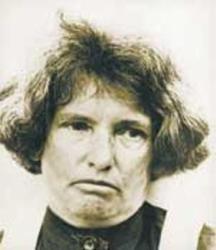
Hawley Crippen
 Great Britain
- Biography of Hawley Crippen
- Early Life
- Life in England and the Murder
- The Investigation and Capture
- Trial and Execution
- Controversies and Recent Developments
Biography of Hawley Crippen
Hawley Harvey Crippen was an American homeopathic physician and dentist who became involved in one of the most high-profile murder cases of the 20th century. He is better known as Dr. Crippen and was executed on November 23, 1910, for the murder of his wife, Cora Henrietta Crippen. Crippen became the first criminal to be captured using wireless telegraphy. In 2007, American forensic scientists cast doubt on Crippen's guilt using DNA testing. In December 2009, the Criminal Cases Review Commission announced that the Court of Appeal would not consider a posthumous pardon for Crippen.
Early Life
Hawley Harvey Crippen was born on September 11, 1862, in Coldwater, Michigan, to Ardesee Skinner and Myron Augustus Crippen, a merchant. He graduated from the Michigan Homeopathic Medical School in 1884. After the death of his first wife, Charlotte, in 1892, Crippen entrusted the care of his 2-year-old son, Hawley Otto, to his parents in California. Crippen became a homeopathic doctor and worked for the pharmaceutical company 'Dr. Munyon's'. His second wife, music hall singer Corrine 'Cora' Turner, known as 'Belle Elmore', was the daughter of a German mother and a Polish-Russian father. In 1900, they moved to England.
Life in England and the Murder
Crippen's American medical qualifications were not sufficient to practice as a doctor in the UK, so he worked as a dentist instead. After moving to different addresses in London, the couple settled at 39 Hilldrop Crescent, Camden Road, Holloway. Cora aspired to an artistic career but blamed her husband for her failures and began to cheat on him. On January 31, 1910, after a party at their home, Cora disappeared without a trace. Crippen claimed she had returned to the US for medical treatment and later announced that she had died and been cremated in California. Meanwhile, his secretary and lover, Ethel 'Le Neve' Neave, moved into 39 Hilldrop Crescent and openly wore Cora's clothes and jewelry.
The Investigation and Capture
Cora's friend, Kate 'Vulcana' Williams, reported the disappearance to the police. A search of Crippen's house produced no evidence, and Chief Inspector Walter Dew's questioning yielded no results. However, Neave and Crippen panicked and fled to Brussels, where they spent a night in a hotel. The next day, the fugitives traveled to Antwerp and boarded the steamship 'Montrose' bound for Canada. Their sudden disappearance prompted Scotland Yard to conduct three additional searches of Crippen's home. During the fourth and final search, the police discovered human remains buried under the brick floor of the coal cellar. Sir Bernard Spilsbury, a renowned pathologist, identified traces of scopolamine in the muscle tissue of the remains. The head, limbs, and skeleton were never found.
While Crippen and Neave were crossing the Atlantic on a ship, Captain Henry George Kendall recognized them and, before the vessel was out of range of land-based transmitters, telegraphist Lawrence Ernest Hughes sent a message via wireless telegraphy: 'Have strong suspicions that Crippen, London murderer, and accomplice are among saloon passengers. Accomplice dressed as a boy.' Dew managed to board the faster liner 'Laurentic' of the White Star Line and alerted the Canadian police, who arrested Crippen and his lover. Crippen was apprehended on July 31, 1910, and brought to England aboard the 'Megantic'.
Trial and Execution
Separate trials were held for Crippen and Neave at the Old Bailey in London. After only 27 minutes of deliberation, the jury found Crippen guilty. He showed no remorse and was hanged at 9 a.m. on November 23, 1910, at Pentonville Prison. As requested, a photo of Neave and letters to her were placed in Crippen's coffin. Neave, however, was acquitted and emigrated to the United States. According to one theory proposed by Edward Marshall Hall, who initially defended Crippen, Crippen accidentally gave his wife a fatal dose of scopolamine, a sedative. In 1981, Hugh Rhys Rankin claimed to have met Ethel Le Neve in Australia in 1930. She alleged that Crippen killed his wife upon discovering she had infected him with syphilis through her extramarital affairs.
Controversies and Recent Developments
Forensic scientist David Foran from Michigan State University conducted DNA testing on the remaining evidence from the Crippen case. The results suggested that the remains actually belonged to a man. Additionally, Foran allegedly discovered a woman named Belle Elmore using one of her aliases in the 1920 New York census data. Although the validity of the research was disputed, it was enough to prompt a demand to repatriate Crippen's remains to the United States.