Hayrem Maxim
 USA
USA- Hiram Stevens Maxim: American Inventor and Industrialist
- The Emperor's Favor
- The American Dream
- Electrical Tycoon
- The War Lost
- European Weaponsmith
- Delicate Work
- Together with five partners (
Hiram Stevens Maxim: American Inventor and Industrialist
Hiram Stevens Maxim, an American-born British subject, was an ingenious inventor. He perfected the incandescent light bulb ahead of Edison and built an airplane before the Wright brothers. Yet, these accomplishments are now forgotten. His name has become synonymous with a different field: he went down in history as the inventor of the deadliest weapon of the late 19th and early 20th centuries.

The Emperor's Favor
In the spring of 1887, a high-profile guest visited the shooting range in Steinfeld, near Vienna, where the Austrian Army tested new models of rapid-fire weapons. Emperor Franz Josef arrived to witness a weapon that was predicted to have a great future. He watched with great approval as two soldiers operated a gleaming, highly polished, five-barreled, rifled machine gun made by the Nordenfeldt company: one would feed cartridges, while the other, carefully turning a crank, fired 180 rounds per minute.
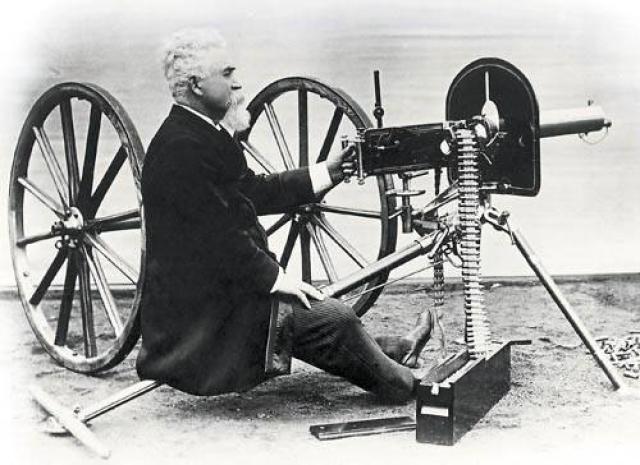
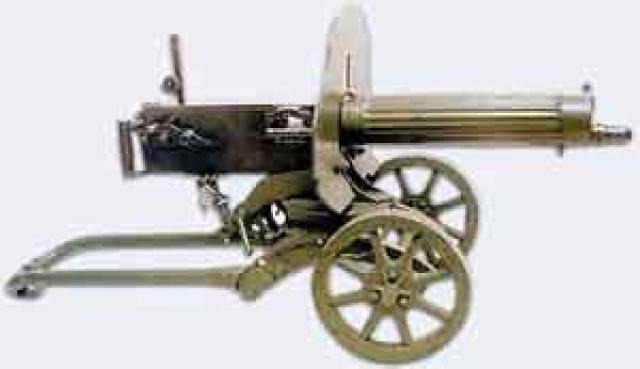
The last participant in the trials was a burly, bearded American—the inventor, promoter, and sole salesperson for a little-known British firm's product: a squat, short, and thick, rather ugly-looking shooting device. Hiram Stevens Maxim, dressed appropriately in a morning suit and a top hat, settled into a tiny seat attached to the rear leg of the awkward tripod, gripping the handles on a black metal box from which emerged a single, water-cooled barrel. At a signal, he opened fire. In 30 seconds, 330 bullets carved out the Emperor's initials—FJ—into a target set a hundred meters away. The smoke was still curling, and the last cartridge case had barely hit the ground when Maxim stood up and bowed to the Emperor. There was dead silence: the Emperor and his entourage were shocked, lost for words.
The American Dream
Hiram Stevens Maxim was born on February 5th, 1840, near Sangerville, Maine. His formal education amounted to less than five years of schooling. From his father, a skilled carpenter and self-taught mechanic, he inherited a knack for working with wood and metal. Even as a boy, Hiram displayed his inventive flair, crafting a chronometer, a spoked wheel for a bicycle, and, eventually, a mousetrap. Later in life, he did not shy away from any kind of work—he was a carpenter, a carriage maker, a painter, a contractor, a professional wrestler, and a bartender. He was literally born for the latter profession: he neither drank himself nor was he too strong for unruly customers to throw out.
He did not serve in the Civil War as he was exempted from the draft after two of his brothers were killed in service. In 1864, Maxim settled in Boston. There he married, and to support his family, took a job with his uncle, Levi Stevens. Hiram quickly solved technical problems, but he lacked the patience to discern important issues from secondary ones. He often "reinvented the wheel" and typically ignored manufacturing and marketing issues.
Levi Stevens manufactured automatic gas generators for home lighting. Maxim was hired as a draftsman, but he promptly came up with improvements for the generator. Hardly had Stevens retooled his factory to produce the new model when his nephew devised further improvements and insisted that the factory be rebuilt once more. When this happened again and again, he was simply fired. However, he found jobs easily, first in Boston and then in New York. Gas and steam were his favorite elements. Maxim adored steam engines. He designed and built pressure gauges, tubes, valves, steam engines, vacuum pumps, carburetors, flywheels, governors, and burners. With his own hands, he built a seven-meter-long steam launch called the Flirt to sail along the Hudson River with his son.
Electrical Tycoon
In 1873, Maxim went into business for himself, founding the Maxim Gas Company, persuading A.T. Stewart, the owner of a chain of department stores and the richest man in America, to back him. He provided gas lighting for the Manhattan post office, a resort in Saratoga, and a hotel in Atlanta, and also devised a brilliant gas searchlight that soon illuminated locomotive engines on all East Coast railroads.
However, Maxim understood that the era of gas lighting was drawing to a close. From 1876 onward, he began working with electricity. His sketches and models impressed New York financiers so much that in June 1878, the United States Electric Lighting Company was organized to commercialize Maxim's inventions.
The executives of the newly created company aimed to take a share of the arc lighting market. While arc lamps served well for lighting streets, they were unsuitable for indoor use since the carbon electrodes were hazardous, needed frequent replacement, and had an unregulated brightness.
Maxim devoted most of his time to developing the incandescent lamp. A race was on between talented inventors to be the first to perfect a lamp that could effectively replace the gas jet in homes and offices. Competition intensified when Thomas Edison entered the fray in 1877. He filed his first patent for an incandescent lamp on October 5th, 1878. Although Maxim filed his application a day earlier, the courts favored Edison. Maxim developed an intense dislike for Edison, who in turn called Maxim a pirate and, after the outbreak of World War I, "a merchant of death."
From the 1870s onward, Maxim's main goal was to beat Edison. He made serious progress toward it. Experimenting with platinum and other materials for the filament, he settled on carbon. Since weak spots in the filament would burn out quickly, Maxim devised a method to make the strands more uniform, developing a process for depositing carbon from hydrocarbon vapors. Edison had to copy the already patented process, which gave Maxim a peculiar kind of satisfaction.
Maxim also patented a voltage regulator, which made it possible to maintain even voltage across all lamps in a circuit. While he could not create a complete vacuum inside the bulb, his lamps worked. By autumn 1880, six months after the Edison Electric Light Company had installed its first commercial electrical lighting system on the ship Columbia, Maxim's company lit up the first building in the United States—the Equitable Life Assurance Company building in New York.
The War Lost
However, it became clear that Maxim had lost the "electric war" to Edison. Unlike Maxim, Edison understood the theoretical interdependencies between voltage, resistance, current, and energy losses in incandescent systems and worked on not only the incandescent lamp itself, as Maxim did, but on the whole infrastructure simultaneously—the lamp, the generator, and the network that would deliver the current to the lamps.
In the meantime, the board of directors at Maxim's company appointed Charles Flint as manager, who quickly realized that U.S. Electric Lighting had no comprehensive electric lighting system, that its patent base was unreliable, and that the company was run by its chief engineer, who was driven by a personal desire for revenge. Thus, after purchasing the Weston Company, which developed electric generators, in 1880, Flint sent Maxim on a lengthy business trip to Europe—ostensibly to acquire foreign patents that would help bypass Edison's patent protection. In reality, Maxim was simply being removed from the scene. In exchange for his shares in U.S.E.L., he was assigned a royalty and a decent salary and made the head of Maxim-Weston's London branch.
Offended but not discouraged, Maxim decided to view his exile as a new opportunity.
European Weaponsmith
In 1881, Maxim married for the second time, traveled to Europe with his new wife, and never returned to the United States again. The Paris World's Fair brought him overwhelming success: an entire room of the exhibition magazine was devoted to Maxim's achievements in electrical engineering. He and Edison were both awarded the Order of the Legion of Honour.
Soon, Maxim took interest in a new field. A chance remark by an American acquaintance in Vienna stuck with him. "Bother with your chemistry and your electricity!" his acquaintance had said. "If you want to make a fortune, invent something that will enable these Europeans to cut each other's throats with greater efficiency." It seemed that while investors in America were crazy about electricity, European financiers fancied weaponry. Thus, instead of reorganizing the Maxim-Weston factory in London, Maxim rented workshops in Hatton Gardens and set out to invent an automatic weapon. The energy with which he threw himself into the new field probably sprang from an obscure need for revenge for his recent defeat.
The drawings were completed in the fall of 1882, and 13 months later, the first working model was ready. Legend has it that the idea had dawned on Maxim when, as a boy, he had shot a bear and realized that the recoil of the heavy gun was wasted energy. However, the gun's mechanism more closely resembled that of a double-acting steam engine, which Maxim had rebuilt so many in his life. The powder gases functioned as steam, the trigger as a valve operator, and the bolt as a piston. The recoil moved the entire bolt, simultaneously ejecting an empty casing and feeding a fresh cartridge. The recoil energy not spent on these movements was accumulated in a spring, which then forced the bolt back in place, locking the breech and firing the chambered cartridge.
Delicate Work
For all its simplicity, Maxim's machine gun consisted of 280 interchangeable parts, most of which had to be manufactured to tolerances that were not yet customary in England. Maxim sent a telegram to his brother Hudson in America, asking him to hire several American machinists urgently and send them over to Europe on the first ship.