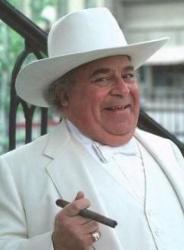
Heinrich George
 Germany
Biography of Heinrich George
Heinrich George, born as Georg August Friedrich Hermann Schultz on October 9, 1893, in Stettin, was a German theater and film actor and theater director. He attended a higher real school in Berlin and studied acting in Stettin. He began his acting career in Kolberg, Bromberg, and Neustrelitz in 1912.
In 1914, George volunteered for the front during World War I and was severely wounded in winter 1915. He was discharged from the army in 1917. Following his service, he worked in theaters in Dresden from 1917 to 1918 and Frankfurt am Main from 1918 to 1921.
In 1920, he made his first appearances in Berlin and permanently moved there in 1922. In 1923, George, along with Alexander Granach and Elisabeth Bergner, founded the Actor's Theatre, an attempt to make well-known actors independent of commercial pressures. From 1925 to 1928, he worked as an actor at the Volksbühne under Erwin Piscator. Additionally, he regularly performed at the theater festival in Heidelberg from 1926 to 1938.
He gained recognition in Weimar Republic cinema for portraying characters who tried to hide their vulnerable nature behind cruel behavior. In 1931, he played the role of Franz Biberkopf in the film "Berlin-Alexanderplatz" directed by Phil Jutzi, based on Alfred Döblin's novel of the same name.
In January 1931, George's success in his first sound films led him to Hollywood, where he participated in the filming of two German-language films for Metro-Goldwyn-Mayer. Upon his return to Germany, he married actress Berta Drews, and they had two sons, Jan George and Götz George, who became a well-known German actor.
In 1937, George was appointed as the intendant of the Schiller Theater in Berlin, which he assumed at the end of 1938 after the reconstruction of the theater building. However, his association with the new regime led to his involvement in important propaganda films such as "Hitler's Youth Quex" (1933), where he played a communist who became a Nazi, and "Jew Süss" (1940) and "Kolberg" (1945) directed by Veit Harlan.
After being denounced, George was arrested by the NKVD in June 1945 and initially imprisoned in Hohen-Schönhausen. He was later transferred to Special Camp No. 2 in Sachsenhausen near Berlin, where he died on September 25, 1946, due to complications from an appendectomy.
In 1994, based on the testimony of a former camp prisoner, George's remains were found and identified in a forest near Sachsenhausen. His grave is now located in the municipal cemetery in Zehlendorf, Berlin. On May 14, 1998, the General Prosecutor's Office of the Russian Federation rehabilitated Heinrich George.