Henri Gouraud
 France
Biography of Henri Gouraud
Henri Gouraud was a French general and participant in the colonial wars in Africa. He was born on November 17, 1867, in Paris, to Dr. Xavier Gouraud and Mary Portal. He was the eldest of six children. The family originally came from Vendée and later moved to Paris. Gouraud received a home education and then studied at the College of Saint Stanislas in Paris and the Saint-Cyr Military School.
Military Career
In 1888, Gouraud joined the 21st Infantry Battalion in Montbéliard. From 1894, he served in African colonial units and fought in Mali, Niger, Chad, Mauritania, and Morocco. In 1907, he was promoted to colonel and appointed as commissioner to the governor general of Mauritania. In 1911, he fought in Morocco and was promoted to brigadier general for his exceptional performance. He also served as the commander of Fes and as an assistant to General Liote.
At the beginning of 1914, Gouraud was appointed as the commander-in-chief of the troops in Western Morocco. After the outbreak of World War I, he led the 4th Brigade of Colonial Moroccan troops to Europe. On September 15, he was promoted to divisional general and became the commander of the 10th Infantry Division. In January 1915, Russian Emperor Nicholas II awarded Gouraud the Order of St. George, 4th class. Later that year, he led the Colonial Army Corps and was then appointed as the commander of the French Dardanelles Expeditionary Corps. During the Gallipoli campaign, he was severely wounded and transported to France on a hospital ship. Gangrene developed during the journey, and his right hand was amputated. On July 10, President Poincare personally visited him in the hospital and presented him with the Military Medal.
After recovering, Gouraud was appointed as the commander of the 4th Army in Champagne at the end of 1915. In 1916, he briefly returned to Morocco as the commander of the local forces. In June 1917, he returned to his position as the commander of the 4th Army and played a brilliant role in the breakthrough of the "Siegfried Line" on the Marne. On November 22, 1918, he entered the city of Strasbourg, overthrowing the Alsatian Soviet Republic, which had been proclaimed there on November 11, 1918. In 1919, Gouraud was appointed as the High Commissioner of France in Syria and Cilicia and as the commander-in-chief of the Levant Army. In 1921, he was captured by Arabs as a hostage near Damascus but was soon released.
Later Life
In 1922, Gouraud returned to Paris and became a member of the Military Council. In 1923, during a trip to the United States, he learned of his appointment as the military governor of Paris, a position he held from 1923 to 1937. He also served on the Supreme Military Council of the Allies in 1927 until his retirement in 1937. During World War II, after the occupation of France by Nazi Germany, Gouraud moved to the south, to the territory controlled by the Vichy government. He returned to Paris after its liberation in May 1945 and passed away on September 16, 1946, in his home.
Awards
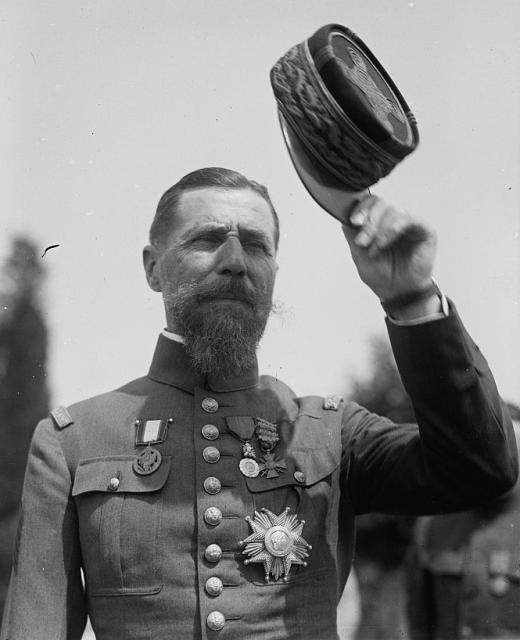
Henri Gouraud was awarded the Order of St. George, 4th class in January 1915. He was also a full Knight of the Legion of Honor, being awarded the rank of Knight (October 18, 1898), Officer (May 31, 1904), Commander (July 11, 1909), Grand Officer (August 10, 1914), and Grand Cross (December 28, 1918). Additionally, he received the Military Medal (July 10, 1915), the Medal for Distinguished Service (United States), the Order of the White Lion (Czechoslovakia), and the Commander of the Order of Nishan al-Anwar.