Henri Konan Bedie
 Ivory Coast
- A diplomat rises through the ranks
- President of Côte d’Ivoire
- A return to opposition politics
- The Sphinx’s final chapter
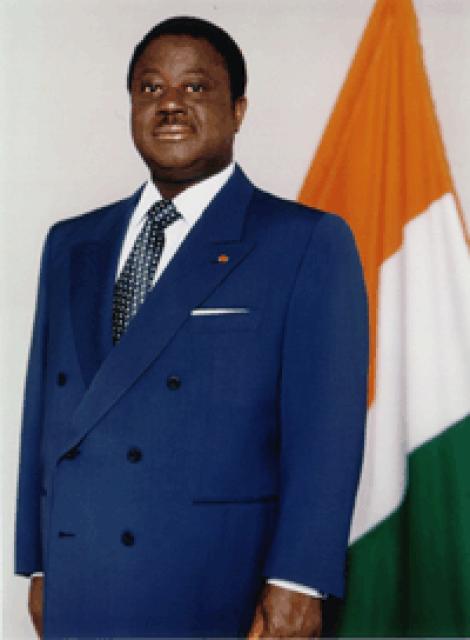
Henri Konan Bédié (5 May 1934 – 1 August 2023), often known by his initials HKB and nicknamed “the Sphinx,” was an Ivorian politician and the country’s second president. He served from 1993 until a military coup removed him in 1999. Before taking office, he was Côte d’Ivoire’s first ambassador to the United States and Canada, finance minister and president of the National Assembly. He later remained a powerful figure in the Democratic Party of Côte d’Ivoire (PDCI-RDA) for decades.
A diplomat rises through the ranks
Bédié was born in Dadiékro, in the Daoukro region of central Côte d’Ivoire. He studied law and economics in France and Senegal, then entered public service after independence. In 1961, at age 26, he became the country’s first ambassador to the United States and Canada. Five years later, he was appointed minister of finance, a post he held until 1976.
After a period at the World Bank, he returned to Ivorian politics and won election to the National Assembly. In 1980 he became its president, remaining in the post until the death of Félix Houphouët-Boigny in December 1993. That position placed him at the center of the constitutional succession and the struggle over who would lead the country after its founding president.
President of Côte d’Ivoire
Bédié assumed the presidency in 1993 and was confirmed in office in the 1995 election. The period was shaped by economic pressure and an increasingly sharp contest over national identity and political belonging. His government promoted the concept of “Ivoirité,” presented as a defense of national identity and cohesion. In practice, rules tied to ancestry and nationality were used to bar opposition leader Alassane Ouattara from running in 1995, while many Ivorians with immigrant backgrounds faced discrimination. The policy deepened political and regional divisions that would continue to affect the country.
Bédié won the 1995 election with an overwhelming majority after most opposition candidates boycotted the vote or were excluded. His government faced criticism over political repression and corruption, as well as the effects of the economic downturn. On 24 December 1999, soldiers led by General Robert Guéï overthrew him in Côte d’Ivoire’s first military coup. Bédié left the country and spent about two years in exile in France.
A return to opposition politics
Bédié returned in 2001 to take part in the National Reconciliation Forum. He later resumed leadership of the PDCI-RDA, the party that had governed Côte d’Ivoire for much of the post-independence period. He sought a return to the presidency in 2010, finishing third in the first round. He then backed Ouattara in the runoff, an alliance that helped bring the two longtime rivals together for a time.
The partnership later broke down. Bédié again became a leading opposition figure and opposed Ouattara’s bid for a third term in 2020. Amid a tense election and deadly political violence, he joined other opposition leaders in rejecting the process and calling for civil disobedience. Though he never regained the presidency, his party organization and political alliances continued to make him one of the country’s most consequential elder statesmen.
The Sphinx’s final chapter
Known for his reserved public manner, Bédié was often called “the Sphinx.” He continued to lead the PDCI-RDA into his late eighties and remained active in preparations for regional elections and the party’s future. He died in Abidjan on 1 August 2023, aged 89, after being taken from Daoukro to a hospital. His legacy is inseparable from both his long influence in Ivorian politics and the divisive identity policies that helped shape its modern conflicts.