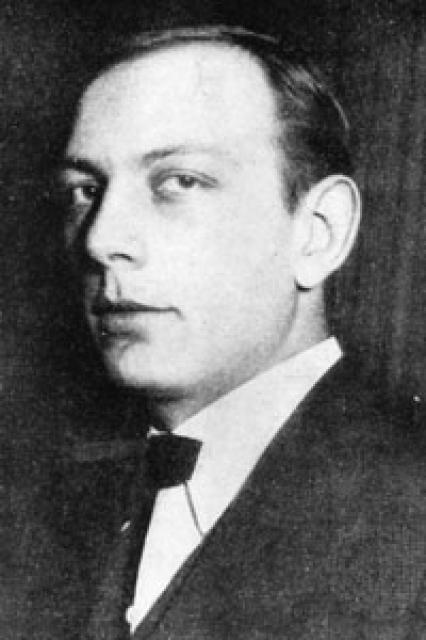
Henri Michaux
 France
Biography of Henri Michaux
French poet and artist with Walloon, German, and Spanish roots. Henri Michaux grew up as a lonely and extremely sensitive child, dissatisfied with himself and those around him, filled with a spirit of resistance. After the occupation of Belgium by the Germans, he attempted to study medicine but dropped out. In 1920-1921, he worked as a sailor, traveling to Germany, Great Britain, South and North America. He lived in Paris from 1924 and became a French citizen in 1955. In 1925, after seeing an exhibition of Surrealists in Paris, he began to paint and create graphics. In 1937, Michaux had his first exhibition of paintings at the "Bibliotheque Pleiade" gallery in Paris. In 1954, he experimented with mescaline for the first time and in 1956, published a book of essays on the effects of drugs called "Miserable Miracles," which included forty-eight drawings by the author. After winning an award at the Venice Biennale in 1960, the first worldwide retrospective of Michaux's paintings and graphics opened in 1964 at the Stedelijk Museum in Amsterdam and the Mott Gallery in Geneva. Subsequent retrospective exhibitions took place in major museums and galleries in Paris and Brussels, Vienna, Stockholm and Lisbon, New York, Montreal, and Tokyo. On June 17, 1997, a similar exhibition was organized by Vadim Kozov with the support of the French Embassy in the Russian State Library of Foreign Literature in Moscow.
Michaux - Author and Artist
Michaux is the author of the book of travel notes on the East called "Barbarian in Asia" (1933, translated into Spanish by Borges in 1941), collections of hallucinatory lyrics and grotesque-fantastic poems in prose such as "Inner Space" (1944), "Life in the Cracks" (1949), "Facing the Bolts" (1954), "Great Trials of the Spirit with the Addition of Countless Smaller Ones" (1966), essays on painting and artists called "Transitions" (1950), collections of aphorisms called "Corner Pillars" (1971), among others, many of which he illustrated himself. He refused the national literary prize of France awarded to him in 1964. As a writer, Michaux never agreed to consider himself equal to his own "passport identity," including his identity as a writer, and fought for the multiplication of possibilities to be someone else using any verbal, visual, musical means (he also composed music). This is why his ordinary common sense is constantly turned inside out, which upon closer inspection cannot be distinguished from absurdity, and why the boundaries between reality and fantasy in his literature, between the depicted and the depiction in his painting and graphics, are erased. "Z Stihotvoreniya Henri Michaux" for mixed choir and orchestra (1963) was composed by Witold Lutoslawski, and "Z" for voice was composed by the French composer Henri Sauguet (1965). Several of Michaux's texts were used in the concert of American singer and composer Diamanda Galas "Defixiones, Will and Testament" (1999, released in 2003), and the vocal-symphonic poem "Songs of the Sea" by Russian composer Valery Gruner (2000) is based on Michaux's poems. At the Avignon Festival in 2006, a performance by Joseph Nadj "Asobu" based on Michaux's book "A Barbarian in Asia" was shown (music by V. Tarasov).


