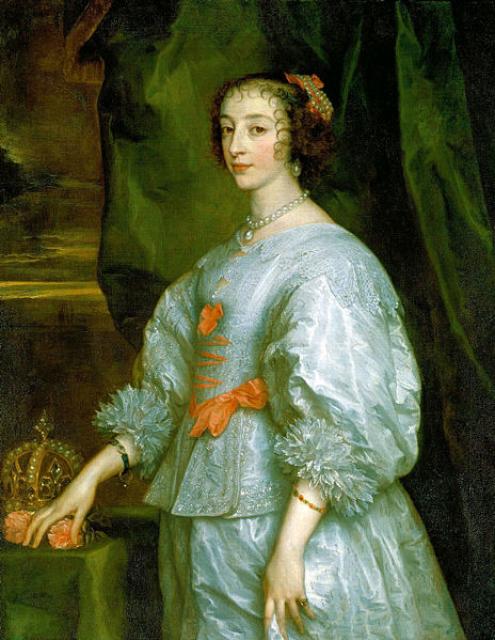
Henriette Marie
 France
- Biography of Henrietta Maria
- Marriage to Charles I Stuart
- Efforts to "Civilize" the English Court
- Supporting Charles I and Exile
- Later Life and Death
Biography of Henrietta Maria
Henrietta Maria was the youngest daughter of French King Henry IV and Marie de' Medici. She was born in the Louvre half a year before her father's assassination and was named after both of her parents. At the age of seven, Marie de' Medici was expelled from Paris, leaving Henrietta-Maria behind. Seven years later, she was married off to the English King Charles I Stuart in 1625, becoming the queen of England, Scotland, and Ireland.
Marriage to Charles I Stuart
When Henrietta Maria arrived in London, she discovered that her husband was under the complete influence of the Duke of Buckingham. Despite living in the same palace, they would go weeks without seeing each other. It was only after Buckingham's assassination that Charles grew closer to his wife and, according to contemporaries, "fell in love" with his queen.
Efforts to "Civilize" the English Court
Henrietta Maria spared no effort in trying to "civilize" the English court according to continental standards. She patronized theaters and supported the arts, but her devout Catholicism alienated Anglican courtiers. As the English Revolution approached, she attempted to rally the French, the Dutch, and the Pope to support her husband, further fueling the fires of the civil war.
Supporting Charles I and Exile
In August 1642, as the conflict escalated, Henrietta Maria traveled to the Netherlands to raise funds for the war against the parliamentarians. The following February, she arrived in Yorkshire and rallied the local population to defend the king. However, in July 1644, Charles's prospects became bleak, and the queen left England. Five years later, her husband was executed.
Later Life and Death
After the execution of Charles I, Henrietta Maria chose to no longer involve herself in politics and focused on raising her children in a Catholic environment. She lived in the Louvre and later in Palais-Royal, while her sons were forced to leave France under pressure from Cardinal Mazarin. She attempted to persuade her youngest son, Henry, to convert to Catholicism, which caused a rift between her and her older son and the English exiles led by Clarendon. Disagreements with her children led Henrietta Maria to retreat to the convent she founded in Chaillot.
Upon hearing news of the Stuart Restoration, she hurried to London in October 1660 to arrange her eldest son's marriage to Catherine of Braganza, a Catholic. She was provided with the luxurious Somerset House and an annual allowance of £60,000. However, the excessive entertainment at the young court clashed with her Catholic beliefs, and she returned to France three times to seek matches for her daughter Henrietta with her cousin, Philippe d'Orléans, and establish their joint life.
Henrietta Maria spent her last four years in France and died a year before her daughter. She was buried alongside her parents in the Abbey of Saint-Denis. The speech delivered by Bishop Bossuet at her funeral gained significant renown.




