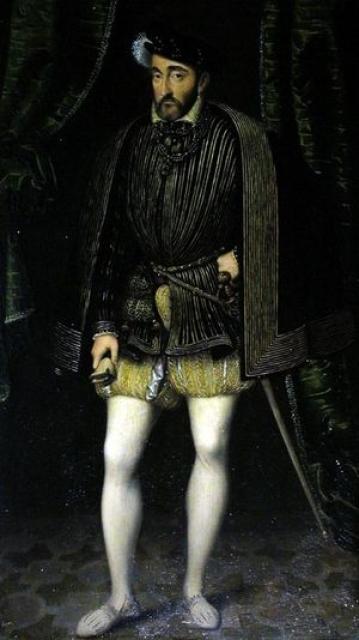
Henrih GUISE
 France
Biography of Henry II
Henry II (March 31, 1519, Château de Saint-Germain-en-Laye - July 10, 1559, Hôtel de Tournelles, Paris) was the King of France from 1547 to 1559. He was the second son of Francis I and Claude of France, the daughter of Louis XII, from the Angoulême branch of the Valois dynasty.
Early Life and Reign
In 1526-1529, Henry, along with his older brother, served as a hostage at the court of King Charles V of Spain instead of their father. In 1531, Henry married Catherine de' Medici. After his brother's death, Henry became the heir to the throne and took command of the army that besieged Perpignan in 1542. During his reign, he fiercely persecuted Protestantism in France.
Wars and Conflicts
Henry continued the war with England after his father's death and concluded it in 1550 by reclaiming Boulogne. In 1548, he found himself in open hostility with Charles V. He allied with German Protestants without opposition from England. Henry launched a surprise attack on Lorraine, capturing Toul, Verdun, and Nancy. However, the attack on Strasbourg was repelled.
Later Years and Death
Henry was successful in his military campaigns in Artua, Hennegau, and Liège, defeating the imperial forces. In Italy, his marshal, Brissac, achieved success in Piedmont. Henry's attempt to conquer Naples with the Franco-Ottoman fleet failed. In 1556, a five-year truce was signed with the emperor, but Pope Paul IV believed that the French court had the right to violate the truce. Thus, in the following year, Henry led an expedition to Italy to conquer Naples, which ended in complete failure.
Legacy
Henry's military campaign on the Netherlands' border was also unsuccessful, resulting in the capture of Constable Montmorency and significant losses for the French aristocracy. Despite a few victories, Henry was forced to return Piedmont according to the Treaty of Cateau-Cambrésis. He left behind a legacy of hostility towards the Protestant Church and arranged a marriage between his eldest daughter and Philip II to strengthen friendly ties. Henry died on July 10, 1559, from a fatal wound sustained during a jousting tournament, despite the efforts of the best physicians of the time, including Vesalius. His death was believed to have been predicted by Nostradamus.