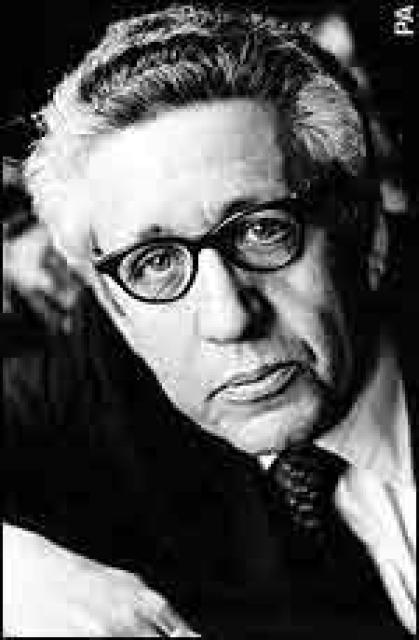
Henry Bernard Levin
 Great Britain
Biography of Henry Bernard Levin
IntroductionHenry Bernard Levin was an English journalist, writer, and television presenter. He was born on August 19, 1928, in London. Levin was renowned for his controversial and influential work, making him one of the most famous British journalists of the second half of the 20th century. His articles and reports evoked a wide range of emotions, from hatred to adoration, leaving no one indifferent.
Early Life and Education
Levin's mother was the daughter of a Ukrainian Jewish immigrant, while his father, of Lithuanian descent, left the family shortly after his birth and only saw his son once when he was already studying at university. Levin's grandfather shared stories of his life in Russia, instilling in Bernard a desperate craving for personal freedom that guided him throughout his life. Despite facing challenges due to his Jewish heritage, Levin earned a scholarship to study at Christ's Hospital, a boarding school in West Sussex. There, he learned to defend his opinions despite mockery and attacks. As a young boy in a funny uniform, simply getting to school was a trial. He declared himself a communist at school and had a modest collection of books on his desk, which he called the "Little Lenin Library." His classmates renamed it the "Little Levin Library" and eventually threw it out the window.
Levin received another scholarship in the late 1940s to attend the London School of Economics, where he immersed himself in a completely different atmosphere. He actively participated in the student union and became involved in politics. Although it was expected that Levin would pursue a career in law after graduating from the London School of Economics, he opted for journalism and initially published under the pseudonym A. E. Cherrimen in "Truth" magazine.
Journalistic Career
Levin's journalistic talent was recognized in 1955 when he was offered a column in the "Manchester Guardian." From 1956 to 1962, he wrote a political column for the "Spectator," and his departure from the newspaper came as a shock as he was expected to become the next editor. Levin later worked for the "Daily Express" and from 1962 to 1970, he was part of "The Daily Mail." However, his longest tenure was at "The Times" from 1971 to 1997, where he expressed his passionate liberal views and disdain for any form of authoritarianism. He wrote about figures such as Osho, a meditation teacher, Eastern European dissidents, apartheid, and support for gay rights, while also expressing frustration over the low quality of various services and sharing his love for fine cuisine. Levin was a regular visitor to the Royal Opera House in Covent Garden, and he frequently discussed his love for Mozart and Wagner with his readers. He also appeared regularly on television, conducting interviews with famous politicians, public figures, and influential people, known for his lack of deference and sharp mannerisms, which were considered unconventional by English standards.
Personal Life
Levin never married but had a reputation as a ladies' man. He dated and later lived with columnist Arianna Stassinopoulos-Huffington, who was 22 years his junior, from 1971 to 1980. Arianna left Levin because he did not want to marry her. After his death, she wrote in "The Sunday Times" that he was the great love of her life. In the late 1980s, Levin began experiencing balance problems, although he was not diagnosed with Alzheimer's disease until the early 1990s. Liz Anderson, with whom he had been together for a long time, cared for him during the prolonged degenerative phase of his illness. Levin passed away on August 7, 2004, in Westminster, London, at the age of 75. He was buried at Brompton Cemetery in London.


