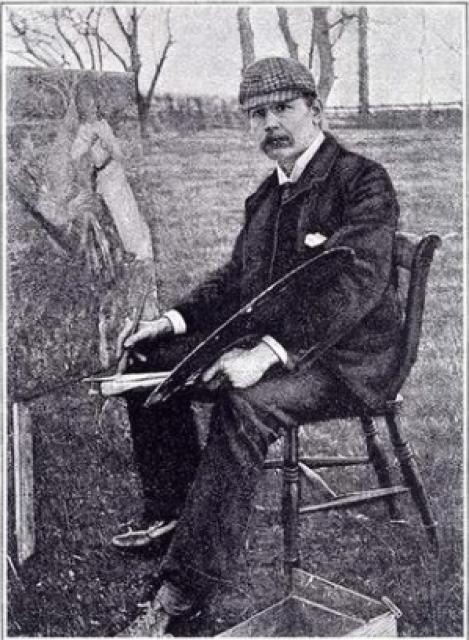
Henry Herbert La Thangue
 Great Britain
- Henry La Thangue: Post-Impressionist and Naturalist Painter
- Training in Paris
- Coastal and Landscape Paintings
- Return to London and the New English Art Club
- Influence of the Newlyn School
- International Recognition
- Later Career and Legacy
Henry La Thangue: Post-Impressionist and Naturalist Painter
Early Life and EducationHenry La Thangue (1859-1929) was an English painter who is best known for his post-impressionist and naturalist style. He received his early education at Dulwich College, where he met fellow artists Stanhope Forbes and Frederick Goodall. He later attended the Lambeth School of Art and, from 1874 onwards, the Royal Academy Schools.
Training in Paris
In 1879, La Thangue was awarded the Royal Academy's gold medal and a scholarship to study at the École des Beaux-Arts in Paris. He received a letter of introduction from Royal Academy President Sir Frederic Leighton to Jean-Léon Gérôme, under whom he studied for three years. During this time, he came under the influence of French naturalist painters and James Whistler.
Coastal and Landscape Paintings
In the summers of 1881 and 1882, La Thangue painted in coastal Brittany, alongside other artists including Jules Bastien-Lepage. In 1883, he traveled to the Rhône Valley, producing landscapes that were exhibited at the Royal Society of British Artists and the Royal Society of Painters in Oil.
Return to London and the New English Art Club
La Thangue returned to London in 1886 and became a member of the New English Art Club. He participated in debates about the club's artistic direction. In the late 1880s, he resided in Norfolk, where he created rural landscapes.
Influence of the Newlyn School
In 1891, La Thangue exhibited at the Royal Academy, showcasing the influence of the Newlyn School of artists. His focus shifted to large-scale, realistic genre paintings that depicted everyday life.
International Recognition
In 1896, at the invitation of James Whistler, La Thangue exhibited his work at the International Society of Sculptors, Painters and Gravers. During the early 20th century, he became increasingly drawn to impressionism, traveling to Provence and Liguria to paint.
Later Career and Legacy
Before the outbreak of World War I, La Thangue held a successful exhibition in Leicester showcasing his paintings of southern Europe. In the 1920s, he returned to Liguria and Spain, continuing to paint scenes of southern landscapes and genre subjects. La Thangue left a lasting legacy as a significant figure in British post-impressionist and naturalist art.


