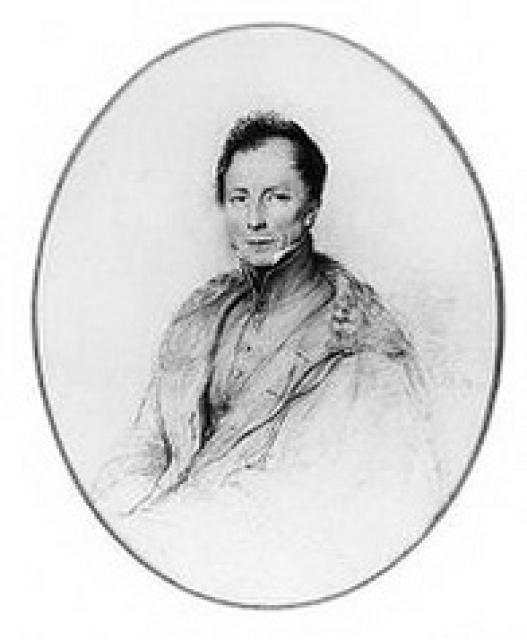
Henry Kater
 Great Britain
- Henry Kater: English Metrologist and Astronomer
- Scientific Career
- Metrological Contributions
- Later Work in Astronomy
- Awards and Recognition
Henry Kater: English Metrologist and Astronomer
Early Life and Military ServiceBorn in England, Henry Kater joined the military in 1794 and served in India for several years, conducting geodetic surveys. Due to health issues, he returned in 1808 and entered the Royal Military Academy in Sandhurst. However, he retired from the military in 1814 as a captain.
Scientific Career
After retiring, Kater dedicated himself to scientific pursuits. His initial research focused on the comparison of light intensity from different telescopes and the determination of the length of the seconds pendulum in London and other parts of England. He developed the reversible pendulum, a device that ingeniously utilized the interchangeability of the point of support and the center of oscillations.
Metrological Contributions
During 1821-1831, Kater published numerous articles on British units of length and mass. In 1832, he provided a crucial comparison of the English yard to the meter, which directly related the Russian foot (1/3 yard) to the meter. Kater's ratio (1 foot = 0.304794494 meters) was subsequently adopted in Russia and served as the basis for metrological calculations in the early 20th century. In recognition of his work, Kater was awarded the Russian Order of Saint Anna in 1814.
Later Work in Astronomy
Kater's later research encompassed practical and observational astronomy, compass design, and methods for determining longitude from lunar eclipses. His findings were published in the "Philosophical Transactions of the Royal Society."
Awards and Recognition
Kater's contributions were widely recognized. He was elected a fellow of the Royal Society of London in 1814 and a foreign member of the Swedish Royal Academy of Sciences in 1826. Among his prestigious awards were the Copley Medal in 1817, the Bakerian Lecture in 1820, and the Gold Medal of the Royal Astronomical Society in 1831.


