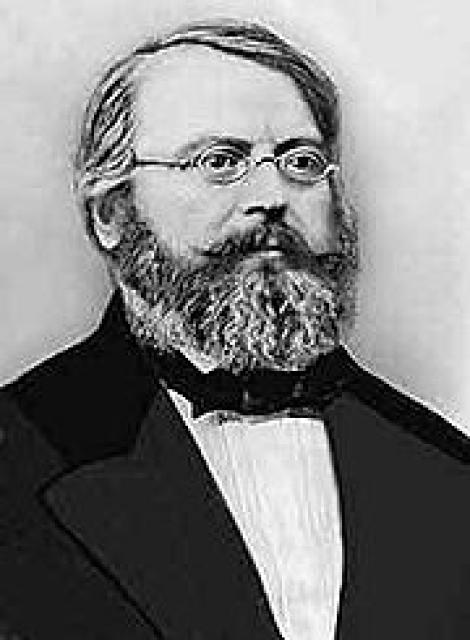
Bogdan Shveytser
 Russia
- Astronomer and Astrometrist
- Stint at the Pulkovo Observatory
- University of Moscow Appointment
- Professor and Director
- Scientific Achievements
- Double Star Discovery
- Moscow Gravity Anomalies
- Cartographic Endeavors
Astronomer and Astrometrist
The renowned Russian astronomer and astrometrist received his astronomical education in Zurich. From 1839 to 1841, he served as the assistant to F.W. Bessel in Königsberg.
Stint at the Pulkovo Observatory
In 1841, he joined the esteemed Pulkovo Observatory, where he worked until 1845. His notable contributions during this period included meticulous observations that formed the cornerstone of the pivotal Pulkovo Star Catalog published in 1845.
University of Moscow Appointment
After departing Pulkovo, he became a supernumerary astronomer at the Observatory of Moscow University (now the Sternberg Astronomical Institute) from 1845. He rose through the ranks, becoming an adjunct professor of astronomy in 1849.
Professor and Director
In 1852, he assumed the role of astronomer at the Konstantian Land Survey Institute. By 1856, he had ascended to the position of Director and Full Professor at the Observatory of Moscow University.
Scientific Achievements
Throughout his illustrious career, he dedicated his research to astrometrics and cartography. With the meticulous accuracy of a master observer, he conducted over 8500 observations using a transit instrument, enriching the field with invaluable data. His keen eye also led to the discovery of four comets and the observation of numerous others for parallax determination.
Double Star Discovery
On November 11, 1864, he made a groundbreaking discovery: a double star within the Pisces constellation (known as NGC 7804). This remarkable achievement further cemented his place in the annals of astronomy.
Moscow Gravity Anomalies
Beyond his celestial pursuits, he dedicated his expertise to investigating the enigmatic gravity anomalies in Moscow. Through meticulous research, he created a meticulously detailed map of these anomalies, attributing their existence to the presence of denser layers within the Earth's crust beneath the Moscow region.
Cartographic Endeavors
As a testament to his versatility, he embarked on a project to calculate the areas of European Russia's provinces at the behest of the Academy of Sciences. His meticulous work contributed significantly to the field of cartography.