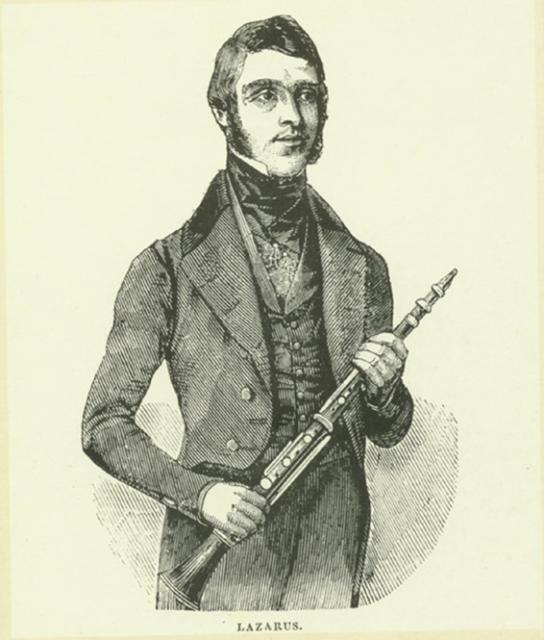
Henry Lazarus
 Great Britain
- Henry Lazarus: Renowned British Clarinetist and Basset Hornist
- Military Service and Debut
- Soloist and Chamber Musician
- Pedagogue and Professor
- Performance and Legacy
Henry Lazarus: Renowned British Clarinetist and Basset Hornist
Early Life and EducationHenry Lazarus was born in England and rose to prominence as one of the most esteemed English musicians of the 19th century. He initially studied bassoon at the Royal Military College, but later switched to clarinet under the guidance of John Blizard.

Military Service and Debut
Upon graduating from the college, Lazarus embarked on a military musical career, serving as an assistant conductor to Charles Godfrey in the Coldstream Guards Orchestra. After retiring from the military, he joined the orchestra of the Duke of Devonshire. His debut public performance took place on May 2, 1838.
Soloist and Chamber Musician
Lazarus rapidly emerged as a prominent figure in England's musical landscape, regularly performing as a soloist and chamber musician. From 1841, he served as a soloist for the Royal Philharmonic Society Orchestra. He also maintained close artistic ties with the Royal Italian Opera and the Birmingham Festival.
Pedagogue and Professor
Lazarus played a significant role as an educator, with Charles Draper being among his most notable students. He became a professor at the Royal Academy of Music in 1854 and at Kneller Hall in 1858. In 1883, he became the first professor of clarinet at the newly established Royal College of Music.
Performance and Legacy
Lazarus retired from performing in 1891 and from teaching in 1894. His playing was characterized by elegance and a clear, resonant tone, ideally suited for chamber music. He experimented extensively with different clarinet models, ultimately settling on Eugene Albert's system. Several composers, including Arthur Clappe, Hamilton Clarke, and George Osborne, dedicated works to him. Lazarus himself composed numerous pieces for the clarinet, including fantasias, cavatinas, and variations.