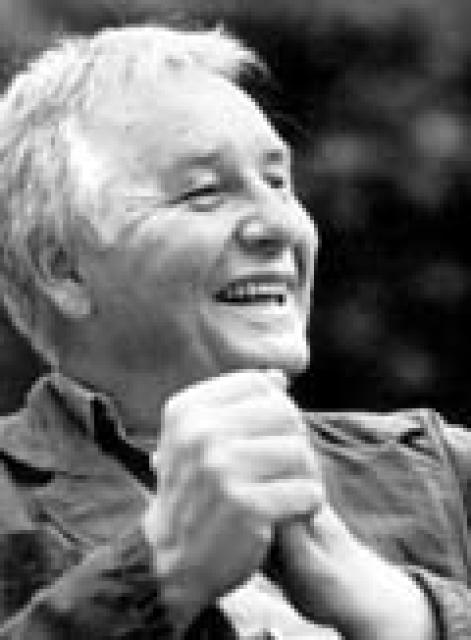
Henryk Guretskiy
 Poland
Biography of Henryk Górecki
Henryk Górecki was a Polish composer born into a modest family with a love for music. At the age of two, he lost his mother. He suffered from bone tuberculosis and spent almost two years in the hospital, undergoing four surgeries. In 1952, Górecki began studying at the Rybnik Higher Music School, where he learned to play the clarinet, violin, piano, and music theory. He completed the four-year course in just three years.
Early Career
Górecki started composing and his initial works, influenced by Szymanowski and Bartók, were performed for the first time in 1958. By the 1960s, he had absorbed the avant-garde experiences of Webern, Xenakis, and Boulez. His First Symphony, performed at the Youth Festival in Paris, gained international recognition. He continued his studies in Paris, where he was influenced by Messiaen and Stockhausen. Despite his success in France, Górecki returned to Poland and, except for a brief stay in Berlin, never left the country.
Teaching and Activism
From 1968, Górecki taught composition at the Katowice Higher Music School, becoming a professor in 1975. He mentored several famous students, such as Eugeniusz Knapik. In 1979, he resigned in protest against the Polish authorities' ban on the visit of Pope John Paul II to the country. Górecki's mature music is an example of sacred minimalism, a movement also represented by composers like Arvo Pärt, Pēteris Vasks, Gia Kancheli, and Sofiya Gubaidulina. His most famous composition is the Third Symphony for Soprano and Orchestra, also known as "Symphony of Sorrowful Songs" (1976). The recording of this symphony by Dawn Upshaw and the London Sinfonietta sold over a million copies and brought Górecki worldwide fame.
Selected Works
- op. 1 Four Preludes for Piano (1955)
- op. 2 Toccata for Two Pianos (1955)
- op. 3 Three Songs (1956)
- op. 4 Variations for Violin and Piano (1956)
- op. 5 Quartettino for Two Flutes, Oboe, and Violin (1956)
- op. 6 I Sonata for Piano (1956/1984/1990)
- op. 7 Songs of Joy and Rhythm for Two Pianos and Chamber Orchestra (1956)
- op. 8 Sonatina in One Movement for Violin and Piano (1956)
- op. 9 Five Little Preludes for Piano (1956)
- op. 10 Sonata for Two Violins (1957)
- op. 11 Concerto for Five Instruments and String Quartet (1957)
- op. 12 Epitaph for Mixed Choir and Chamber Ensemble (1958)
- op. 13 Five Pieces for Two Pianos (1959)
- op. 14 I Symphony "1959" for String Orchestra and Percussion
- op. 15 Three Diagrams for Solo Flute (1959)
- op. 16 Monologues for Soprano, Two Harps, and Percussion (1960)
- op. 17 Scontri for Orchestra (1960)
(Note: The list of works continues, but due to character limitations, only a selection is included here)