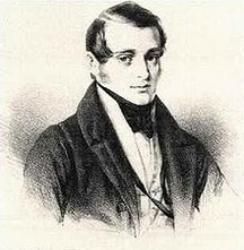
Heorh Handel
 Great Britain
Biography of George Frideric Handel
George Frideric Handel, one of the most celebrated composers of the Baroque period, was born on February 23, 1685, in Halle, Saxony. Despite his father's initial opposition to his musical pursuits, Handel was allowed to study organ with a local organist starting at the age of eight. After his father's death in 1702, Handel enrolled in the law school at the University of Halle but was quickly appointed as the cathedral organist.
In 1703, Handel moved to Hamburg, where he initially worked as a violinist and later as a harpsichordist in the Hamburg Opera, the only opera theater in Germany at that time. It was in Hamburg that Handel composed his first operas, including "Almira" in 1705. In 1706, he traveled to Italy, where he composed Italian cantatas, oratorios, and operas, and had the opportunity to meet famous Italian composers such as Arcangelo Corelli and Alessandro and Domenico Scarlatti.
In 1710, Handel moved to London and became the court composer for George, Elector of Hanover, who would later become King George I of England. Handel quickly gained popularity in London with his opera "Rinaldo" in 1711. After the death of Queen Anne in 1714, Handel's relationship with the new king, George I, became strained. However, after composing the "Water Music" for a royal boat trip in 1715, Handel was forgiven and received a yearly pension.
In 1717, Handel became the composer for the Duke of Chandos and composed several anthems and pastorals during his time there. In 1720, he co-founded the Royal Academy of Music, which presented Italian operas in London. Handel's opera career faced challenges in the 1730s due to the success of the English-language opera "The Beggar's Opera," but he continued to compose and perform.
In 1737, Handel experienced a financial and health crisis, but he recovered and shifted his focus to composing English oratorios, which did not require expensive sets and Italian singers. His most famous oratorio, "Messiah," was composed in 1741. Handel continued to compose oratorios and other choral works, including "Judas Maccabaeus" and "Israel in Egypt," until his health deteriorated in the 1750s.
Handel passed away on April 14, 1759, and was buried in Westminster Abbey. His funeral was attended by thousands, and his legacy as one of the greatest composers of all time continues to live on.