Herman Minkovskiy
 Germany
- Biography of Hermann Minkowski
- Education and Early Career
- Contributions and Academic Career
- Geometric Interpretation of Relativity Theory
- Later Life and Legacy
- Contributions to Mathematics
Biography of Hermann Minkowski
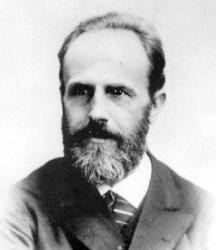
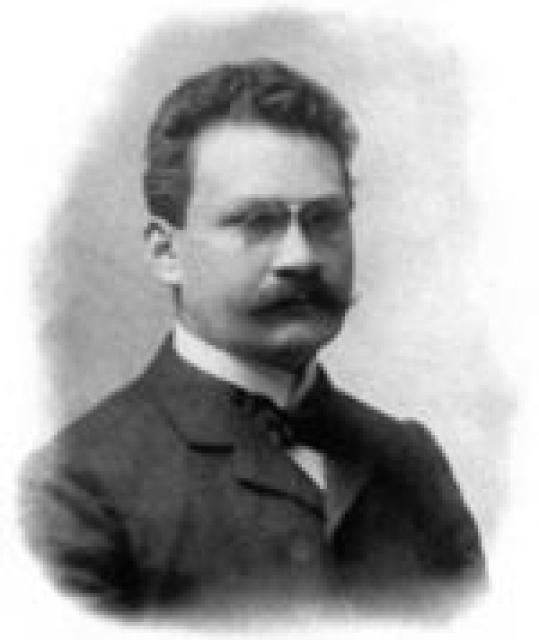
Hermann Minkowski was a German mathematician who developed the geometric theory of numbers and a geometric four-dimensional model of the theory of relativity. He was born in Aleksotas, a suburb of Kaunas in Lithuania, which was then part of the Minsk Governorate, to a German Jewish family. His parents were Levin Minkowski and Rahel Taubmann. He had a brother named Oscar Minkowski, who also became a renowned scientist in the field of physics.
Education and Early Career
In 1872, Minkowski's family returned to Germany and settled in the city of Königsberg. He completed his secondary education in 1879 and then studied at the universities of Königsberg and Berlin under prominent mathematicians such as Lindemann, Kronecker, Weierstrass, and others. Among his fellow students was David Hilbert.
Contributions and Academic Career
In 1881, as a student, Minkowski submitted a paper on the theory of quadratic forms to the competition of the Paris Academy. Despite being written in German instead of the required French, the paper received the prize and enthusiastic reviews from the jury in 1883. He obtained his doctorate in 1885 with a dissertation on the theory of quadratic forms in spaces with an arbitrary number of variables.
After teaching at the University of Königsberg for a while, Minkowski moved to Bonn in 1887, where he became an extraordinary professor in 1892 and an ordinary professor in 1894. He returned to Königsberg in 1895 but soon relocated to Zurich in 1896. In Zurich, he became one of Einstein's teachers.
In 1902, Minkowski began working at the University of Göttingen, where he remained until his death. He was a professor of mathematics and worked closely with his close friend Hilbert. During this time, one of his students was Constantin Carathéodory. In 1896, he published the monograph "Geometry of Numbers," which compiled all his achievements in this field. In 1907, he published another monograph called "Diophantine Approximations."
Geometric Interpretation of Relativity Theory
In 1907-1909, Minkowski presented a series of articles and lectures proposing the concept of "geometrodynamics," a four-dimensional mathematical model of the kinematics of the theory of relativity. In 1909, his book "Space and Time" was published, which was destined to become his scientific legacy. Einstein highly valued Minkowski's contribution to the development of relativistic theory.
Later Life and Legacy
In 1909, Minkowski tragically died from appendicitis in Göttingen. In 1911, Hilbert published a complete collection of his friend's works. In honor of Hermann Minkowski, a crater on the moon was named after him, as well as the asteroid 12493 Minkowski.
Contributions to Mathematics
Minkowski's early results focused on the theory of quadratic forms. In 1896, he presented the famous lemma known as "Minkowski's Convex Body Theorem," which states that a convex region in n-dimensional space, symmetric with respect to the origin and with a non-zero volume, must contain at least one point with integer coordinates different from the origin. According to Cassels, the entire geometry of numbers is based on this lemma.
After developing the geometry of numbers, Minkowski worked extensively on applying his results to other areas of number theory, such as Diophantine approximations and the theory of polyhedra. He made fundamental contributions to the geometry of convex bodies.
Minkowski also made significant contributions to hydrodynamics and the theory of capillarity.
Minkowski's geometric interpretation of the theory of relativity, introducing the four-dimensional pseudo-Euclidean space known as Minkowski space, greatly aided Einstein in the development of the general theory of relativity, which built upon similar ideas.
Minkowski famously proclaimed, "Henceforth space by itself, and time by itself, are doomed to fade away into mere shadows, and only a kind of union of the two will preserve an independent reality."